
Climate & Environment
Climate is the biggest single lever on an indoor grow. You can run the best nutrients and the brightest light on the market and still lose the crop to a room that sits too hot, too humid or too still. Get temperature, humidity and airflow right for each stage and everything else starts working. This guide gives you the targets, then the kit that hits them.
Shop climate & environment by type
Climate & environment gear we carry

Temperature & Humidity
Temperature & Humidity
AC / Dehumidifiers / Humidifiers

Ducting & Accessories


Carbon & Intake Filters
AC Infinity PRE-FILTER FOR INLINE CARBON FILTER – 4-INCH, 2-PACK


Inline / Booster Fans


Wall / Floor / Stand Fans


Odour Control


Hangers & Ratchets
Temperature & Humidity
Temperature & Humidity
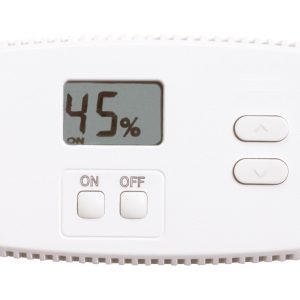
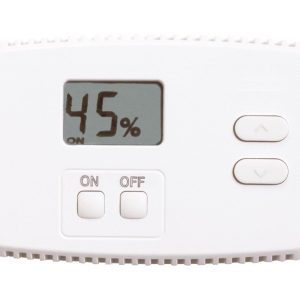
Anden Digital Dehumidifier Control (For All Anden Dehumidifiers)
Temperature & Humidity
Ventilation and airflow: sizing the system that does most of the work
Ventilation does three jobs at once. It removes heat, it removes the humidity your plants exhale, and it replaces stale, CO2-depleted air with fresh. Get it right and it does most of your climate control for free. The heart of the system is an inline extractor fan pulling air out through a carbon filter, with a passive or active intake bringing fresh air in low. Hot, humid air rises, so extract from the top of the tent and let cool air enter near the floor.
Sizing is where most setups fail. Your extractor should exchange the whole volume of the tent roughly once a minute. Work out the volume in cubic meters (width x depth x height), multiply by 60 to get the per-hour figure a fan is rated in, then add headroom, because a carbon filter, bends in the ducting and a hot lamp all rob a fan of real-world airflow. A small 4ft by 4ft tent is about 100 cubic feet, so the bare minimum is around 100 CFM, but with a filter fitted you want a fan rated nearer 200 to 250 CFM and turned down, rather than a weak fan flat out. Brands like Can-Fan, Active Air and AC Infinity cover the common tent sizes, and AC Infinity’s controllable fans are worth the extra because they ramp to hold a set temperature instead of running at one fixed speed.
Extraction handles the air leaving the room. Circulation handles the air inside it, and it is just as important. A couple of oscillating or clip fans keeping the canopy in gentle motion strengthen stems, break up the pockets of still, humid air where mold takes hold, and even out temperature from top to bottom. Hurricane and similar oscillating fans do this cheaply. Aim for leaves that flutter, not thrash. Run your carbon filter inside the tent on the fan’s intake side so odor is scrubbed before the air is pushed out, and match the filter and ducting diameter to the fan (4-inch, 6-inch, 8-inch) so you never choke the airflow you paid for.
CO2 & equipment safety
CO2 enrichment displaces breathable air in enclosed spaces. Run enrichment only in rooms people and pets don't sleep in, use a CO2 monitor or controller with an alarm rather than guesswork, and ventilate before working at length in an enriched room. Follow generator and regulator manuals exactly — gas burners also add heat and moisture that must be vented per the manufacturer. Electrical gear in a humid grow space belongs on protected circuits, clear of water. Per-product safety limits are on each product page.
Talk to a real grower
Not sure what your space needs? Tell us your setup and goals — we run these systems ourselves and answer same-day.
Talk to a GrowerBrowse all productsClimate & Environment buying guide
Why environment beats nutrients and lights
Here is the order of priority most growers get wrong. They spend on nutrients and lighting, then treat the environment as an afterthought, a fan bolted on at the end. It is backwards. A plant does not respond to what is in the tank or how many watts hang above it; it responds to the conditions its leaves actually sit in. Push the room out of range and the plant closes its stomata, stops drinking, stops feeding and stops growing, no matter how good the feed chart is.
The reason is simple. Photosynthesis, transpiration and nutrient uptake are all driven by temperature and humidity working together. Those two numbers set how fast water moves from the reservoir, through the roots, up the plant and out of the leaf. When that flow is right, the plant pulls nutrients up with it and grows hard. When it is wrong, the most expensive bloom booster on the shelf sits unused in the tank.
So the honest advice is to fix the room first. Set your targets by growth stage, buy the kit that holds those targets steady, and only then fine-tune light and feed. The rest of this guide is built that way: the numbers your plants want at each stage, then the fans, filters, dehumidifiers and controllers that hit them.
Two of the biggest inputs to your climate get their own guides: lighting, usually the main heat source, and hydroponic systems, which drive reservoir temperature and humidity load.
Temperature by growth stage (and the dark-period trap)
Most indoor plants are happiest with daytime air between 68 and 81°F. Inside that band, run the warmer end, around 75 to 81°F, in early veg when you want fast growth, and the cooler end, around 68 to 75°F, through flower to protect terpenes, color and flower density. Clones and seedlings like it warm and still, around 72 to 79°F, because young roots establish faster in gentle warmth.
The number growers forget is the dark-period temperature. Lights-off should sit a few degrees below lights-on, but not by a huge margin. A drop of 5 to 10°F mimics nature, and in late flower a slightly cooler night helps bring out color in some genetics. The trap is letting the room crash 18°F or more when the lights and ballasts stop throwing heat, because a cold night pushes relative humidity up sharply and that is where mold starts. Consistency beats a dramatic swing.
Watch the canopy, not the corner. The air right under a strong LED or HID fixture can run several degrees hotter than the wall thermometer suggests, and that hot spot is what stresses the top of the plant. If your room runs hot in summer, an extractor upgrade solves it far more cheaply than air conditioning. If you are fighting heat you simply cannot vent away, that is when a proper AC unit earns its place.
Humidity by stage: high for clones, dry for flower
Humidity should fall as the plant grows, and getting that curve right prevents most crop diseases before they start. Clones and seedlings have few or no roots, so they drink through their leaves and need a moist, sheltered environment, around 70 to 75% relative humidity under a propagator lid. As roots develop through early veg, bring it down to roughly 60 to 70%. By late veg you want 55 to 65%.
Flower is where humidity control earns its keep. Drop to 50 to 60% in early bloom, then step down to 40 to 50% through mid and late flower. Dense, mature flowers hold moisture, and once the buds fatten a humid room is an open invitation to botrytis (bud rot), which can hollow out a plant from the inside in days. The last two to three weeks are the highest-risk window, and keeping the room dry and moving is the single best defense.
The hard part is that plants transpire a large amount of water into the air, so a full flowering room climbs in humidity on its own, fastest at night when it is cooler. Extraction removes some of it, but past a certain canopy size, and in a humid climate, you will not hold 45% with a fan alone. That is the point where a dehumidifier stops being optional. Size it to pull pints per day, not for a single room-check reading.
VPD: the one number that combines heat and humidity
Vapor pressure deficit (VPD) is the figure serious growers dial in instead of chasing temperature and humidity separately, because it combines both into the one thing the plant actually feels. In plain terms, VPD measures how strongly the air pulls moisture out of the leaf. Too low and the plant cannot transpire, so it barely drinks or feeds. Too high and it transpires faster than the roots can supply, so it panics and shuts its stomata. Either extreme stalls growth, which is why two rooms at the same temperature can perform completely differently at different humidities.
VPD is measured in kilopascals (kPa) and, like humidity, it should rise as the plant matures. Young plants want a low, gentle VPD; flowering plants want a stronger pull. You do not need to calculate it by hand, because a chart or a controller reads it for you from temperature and humidity. Use the table below as your working target, remembering that leaf temperature runs a degree or two below air temperature, which nudges real VPD slightly higher than an air-only reading suggests.
| Stage | Air temp | Humidity | VPD | Notes |
|---|---|---|---|---|
| Clone / seedling | 72–79°F | 70–75% | 0.4–0.8 kPa | Warm, still, humid; roots form without transpiration stress |
| Early veg | 72–82°F | 60–70% | 0.8–1.1 kPa | Ramp airflow as leaf area grows |
| Late veg | 72–82°F | 55–65% | 1.0–1.2 kPa | Build frame; strengthen stems with airflow |
| Early flower | 72–79°F | 50–60% | 1.2–1.4 kPa | Begin drying the room as buds set |
| Mid / late flower | 68–75°F | 40–50% | 1.4–1.6 kPa | Keep dry and moving to dodge botrytis |
Treat these as targets to steer toward, not hard limits that ruin a crop the moment you drift. Hold the averages, avoid big swings, and let the plant confirm you are right: healthy, flat, praying leaves and steady growth mean your VPD is in the zone.
CO2 enrichment: when it pays and when it is a waste
Carbon dioxide is the raw material of photosynthesis, and enriching it can lift yield, but only when everything else is already dialled in. Normal air sits around 400 parts per million (ppm). Supplementing to 1000 to 1500ppm lets a plant photosynthesize faster, which is why commercial rooms run it. The catch is that CO2 only pays off under high light and warmer temperatures, around 82 to 86°F, because the plant needs the light energy to use the extra carbon. Enrich a tent under a modest light and you gain almost nothing.
There is also a hard rule that makes CO2 an advanced step: a sealed room. There is no point injecting CO2 if your extractor is pumping it straight back outside, so enrichment means running a sealed environment with air conditioning and a dehumidifier doing the climate work that ventilation normally does. That is a bigger, more expensive setup, which is why we tell most home growers to master ventilation first and come to CO2 later.
If you do run it, do it properly with a controller and a sensor rather than a timer guessing at a dose. Autopilot makes monitors and controllers that hold a target ppm and shut off in the dark, when plants do not use CO2. Delivery is either a regulated bottle for a tent or a burner for a larger room. One safety point that is not optional: CO2 at enrichment levels is dangerous to breathe, and a burner also produces heat and water vapor, so ventilate before you enter and never run high CO2 in an occupied space.
Monitoring and automation: measure at the canopy, then let a controller hold the line
You cannot hold a target you are not measuring, so a thermo-hygrometer is the cheapest high-value tool in the room. Place it at canopy height, where the plant lives, not on the floor or clipped to the top bar, because that is the only reading that reflects what your plants actually experience. A model that logs the minimum and maximum since you last checked is worth having, because it catches the cold, damp reading at 3am that you would otherwise sleep through. Active Air makes simple hygro-thermometers that do exactly this.
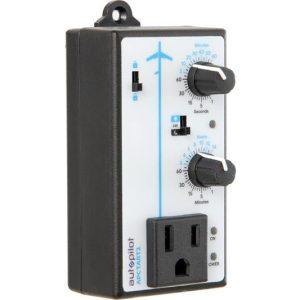
Manual control works, but it means you are the thermostat, and you are not there at night. This is where a controller changes things entirely, taking over fans, a dehumidifier, a heater and CO2 and running them to keep the room inside your target band automatically. At the tent scale, AC Infinity’s environmental controllers pair with their fans to ramp extraction up and down against live temperature and humidity, and their newer units read VPD and add a CO2 sensor. For a room, Autopilot controllers like the ECLIPSE range manage temperature, humidity and CO2 together from one unit, while simpler Autopilot thermostats, humidistats and recycling timers cover single jobs if you are building up gradually.
The principle to buy on is this: automate the thing that fails while you are asleep. For most indoor growers that is night-time humidity, so a controller running a dehumidifier off a humidistat is the upgrade that saves the most crops. Start with accurate measurement, add automation where the risk is highest, and let the kit hold the line so you are not chasing the room by hand twice a day.
Troubleshooting: four common faults and the kit that fixes them
Most climate problems come down to four recurring faults. Here is how to read each one and the kit that fixes it for good.
Mold and botrytis (bud rot). Gray fuzz on leaves, or brown, dying patches inside otherwise healthy flowers, means the air is too humid and too still, usually in late flower. The fix is layered: drop the room to 40 to 50% humidity with a dehumidifier sized to your canopy (Anden and Quest build the commercial-grade units that hold a large flowering room steady), improve extraction, and add circulation so no pocket of air sits wet. Prevention beats cure here; once botrytis is inside dense flowers, the affected heads have to come out.
Hot spots and heat stress. Leaves cupping or curling upward, and tacoing directly under the light, mean the canopy is too hot even if the wall reads fine. Raise the light, increase extraction first, and if you still cannot vent the heat, an AC unit is the real answer. In a cold garage or basement the opposite applies, and a thermostat-controlled heater stops a freezing night stalling growth and spiking humidity.
Stale, still air. Weak stems, slow growth and drooping between waterings often mean poor air exchange and no internal movement. Right-size the extractor and carbon filter, check your ducting is not crushed or full of sharp bends stealing airflow, and add circulation fans to keep the canopy moving.
Night-time humidity spikes. A room that behaves all day, then climbs past 60% at lights-off, is the classic cool-night problem, because cooler air holds less moisture. Close the temperature gap between day and night, run the dehumidifier off a humidistat or controller so it works hardest while you sleep, and keep a small amount of air moving overnight. If dry air is the opposite issue, in a heated room in winter, a humidifier on a humidistat holds the veg and clone humidity your young plants need.
Frequently asked questions
What temperature and humidity should my grow room be?
Aim for daytime air of 68 to 81°F at every stage, running warmer in veg and cooler in flower. For humidity, follow the plant down: 70 to 75% for clones, 60 to 70% in early veg, and 40 to 50% through flower. Keep the lights-off temperature only a few degrees below lights-on.
What is VPD and do I need to worry about it?
VPD (vapor pressure deficit) combines temperature and humidity into one figure that reflects how hard the air pulls moisture from the leaf. It is the most accurate way to set your climate. Aim for roughly 0.4 to 0.8 kPa for clones, rising to 1.4 to 1.6 kPa in late flower. A controller or a printed chart works it out for you.
How do I size an extractor fan for my tent?
Calculate the tent volume in cubic meters (width x depth x height) and aim to exchange it about once a minute, so multiply that volume by 60 for the per-hour rating fans use. Then size up by 25 to 50%, because a carbon filter, ducting bends and hot lamps all reduce real airflow. A weak fan fitted with a filter will not keep up.
Is CO2 enrichment worth it for a home grow?
Only once the basics are perfect. CO<sub>2</sub> at 1000 to 1500ppm boosts yield in a sealed room under strong light and warmer temperatures, but it is wasted if your extractor vents it straight outside or your light is modest. Master ventilation, temperature and humidity first, then consider it as an advanced upgrade with a proper controller and sensor.
How do I stop bud rot and mold in flower?
Keep flowering humidity at 40 to 50%, drop it further in the last two to three weeks, and never let the room go still. A dehumidifier sized to your canopy, good extraction and a couple of circulation fans together break the humid, stagnant conditions botrytis needs. It is far easier to prevent than to cure.
Do I really need a dehumidifier?
Once your canopy fills out in flower, very probably. Plants release a lot of moisture into the air, humidity climbs at night, and a humid outdoor climate makes it worse, so extraction alone often cannot hold 45%. A dehumidifier on a humidistat is the single most reliable way to keep a flowering room dry and mold-free.
Is this what you need?
- A good fit if your temps or humidity swing outside range daily, you're sealing a room, or you're scaling past one tent.
- Climate gear can't rescue a grow that's short on light or feeding — fix those limits first, then stabilize the environment.
- Size to your space: an oversized dehumidifier or AC in a small tent short-cycles and wastes money — match capacity to room volume.
- CO2 enrichment only pays in a sealed, brightly lit room running near its ceiling — in a vented tent it literally blows away.
Written and reviewed by the Premier Hydro Growers team. Figures and ranges are general starting points; always follow the manufacturer's instructions and adjust to your own plants, water and setup.