


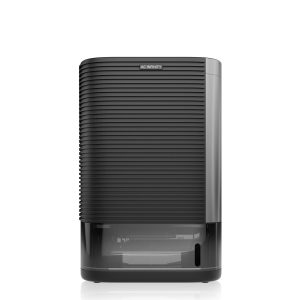
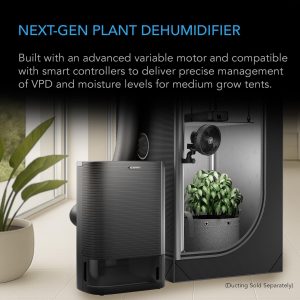


The AC Infinity HYDRONE 5 is a plant dehumidifier built for small to medium grow spaces, delivering precise humidity reduction across 10 distinct levels via a high-precision PWM motor. Engineered to raise VPD levels from seed to flower, its proprietary all-climate design performs reliably in both hot and cold environments—covering spaces up to 5×5 ft and beyond. An exhaust port lets you duct dry air directly into a grow tent, while an optional intake port enables a closed-loop humidity control system. Pair it with AC Infinity’s UIS™ controllers to add WiFi connectivity, AI-powered automations, real-time alerts, and grow tracking.
HYDRONE 5 Specifications
Key specifications for the AC Infinity HYDRONE 5 Dehumidifier (SKU: AC-DHT5), derived from manufacturer product data and supplier documentation.
| Specification | Value |
|---|---|
| Brand | AC Infinity |
| Model | HYDRONE 5 |
| SKU | AC-DHT5 |
| Product Type | Plant Dehumidifier |
| Dehumidification Levels | 10 (high-precision PWM motor) |
| Coverage Area | Up to 5×5 ft grow spaces and larger |
| Weight | 10 lb (10.0002 lb) |
| Exhaust Port | Yes — ducts dry air into grow tent |
| Intake Port | Optional — enables closed-loop humidity control |
| Climate Performance | All-climate (hot and cold environments) |
| Controller Compatibility | AC Infinity UIS™ controllers (WiFi, AI automations, alerts) |
Why Choose the HYDRONE 5
The HYDRONE 5 is designed specifically for plant cultivation environments, not general household use. Several features separate it from generic dehumidifiers when used in a grow space:
- 10-level PWM motor control: Rather than cycling on and off at a fixed output, the high-precision PWM motor lets you dial in one of 10 dehumidification levels. This gives you fine-grained control over humidity drawdown speed, which matters when managing VPD transitions between vegetative and flowering stages.
- All-climate proprietary design: Many residential dehumidifiers degrade in performance at lower temperatures—a common issue in basement or garage grows during winter months. The HYDRONE 5 is built to maintain peak performance in both hot and cold environments, so your humidity control stays consistent year-round.
- Ducting-ready exhaust port: The built-in exhaust port lets you channel dry air directly into a grow tent or a specific zone of your space. This directional drying is more efficient than relying on ambient air distribution alone.
- Closed-loop capability with optional intake port: Configuring the intake port creates a sealed humidity control loop—intake pulls air from the grow space, the unit dehumidifies it, and the exhaust returns dry air back in. This approach is notably more efficient than open-loop operation.
- UIS™ integration for automation: Connecting a compatible AC Infinity UIS controller adds WiFi scheduling, AI-powered humidity automations, real-time alerts, and historical data tracking via the AC Infinity app. Manual operation is also available without a controller.
Best Uses for the HYDRONE 5
The HYDRONE 5 fits a specific range of applications within indoor plant cultivation. Consider it for:
- Small to medium grow tents (up to 5×5 ft): This unit is sized and rated for grow tent footprints up to 5×5 ft. Growers running a 2×4, 3×3, 4×4, or 5×5 tent will find the coverage capacity appropriate for the space without over-sizing the unit.
- VPD optimization from seed to flower: VPD (vapor pressure deficit) requirements shift significantly across the plant life cycle. Young seedlings and clones need higher humidity; late-flowering plants benefit from lower humidity to prevent mold and trichome preservation. The 10-level adjustment makes it practical to step humidity down gradually as plants mature.
- Mold and powdery mildew prevention: Dense canopies in late flower—particularly strains susceptible to botrytis or powdery mildew—benefit from active humidity reduction rather than relying on passive airflow alone. The HYDRONE 5 provides targeted drawdown in the grow environment rather than dehumidifying the entire room.
- Year-round humidity management in variable climates: In climates where ambient humidity varies significantly between seasons, a dedicated grow-space dehumidifier provides a controllable baseline rather than leaving humidity correction entirely to the HVAC system. The all-climate design makes this viable in winter as well as summer.
- Integrated AC Infinity grow room setups: If you already run AC Infinity inline fans, speed controllers, or environmental controllers, the HYDRONE 5 connects into the same UIS ecosystem. A single app then manages multiple climate variables together rather than requiring separate control interfaces.
HYDRONE 5 vs Similar Products
The HYDRONE 5 occupies the mid-range of AC Infinity’s HYDRONE dehumidifier lineup, sitting between the HYDRONE 3 (smaller capacity) and the HYDRONE 7 (larger coverage area). If you are deciding between models within the series:
- The HYDRONE 3 is suited for smaller spaces—2×2 to 3×3 ft tents—where the HYDRONE 5’s capacity would outpace what the space needs.
- The HYDRONE 7 targets larger grow rooms or tents beyond 5×5 ft, where the HYDRONE 5 may struggle to keep up with the total moisture load.
- All three share the same PWM motor technology, UIS compatibility, and all-climate design. The primary differentiator is dehumidification capacity relative to room volume.
Compared to general-purpose residential dehumidifiers in a similar price range, the HYDRONE 5 offers purpose-built features growers need: direct ducting capability, PWM-level granularity rather than simple on/off cycling, and ecosystem integration with environmental controllers. Residential units typically lack these features, particularly the exhaust port for directed airflow into a tent.
For growers who need a condensate management solution alongside their dehumidifier, a condensate pump may also be worth considering to handle the collected water output automatically rather than manually emptying a reservoir.
Compatibility
The HYDRONE 5 is designed to operate within AC Infinity’s UIS™ (Universal Intelligence System) ecosystem. Compatibility details based on available product information:
- UIS™ controllers: The unit connects to compatible AC Infinity UIS controllers, enabling WiFi app control, AI-powered scheduling, real-time humidity alerts, and historical data logging. Controller sold separately.
- Standalone operation: The HYDRONE 5 also operates independently without a controller using manual level selection—no UIS connection required for basic use.
- Grow tents and enclosures: The exhaust port accepts standard ducting for directing output into a grow tent’s intake or internal space. The optional intake port can draw air from inside the tent to create a closed-loop system.
- Climate pairing: The unit pairs logically with inline fans and carbon filters for a complete climate stack. Running it alongside an oscillating or pedestal fan helps distribute the dehumidified air more evenly throughout the grow space.
- Humidity monitoring: For growers wanting to track humidity levels independently, a standalone humidity buffer or monitoring solution can complement the HYDRONE 5’s active dehumidification with passive humidity stabilization in sealed storage areas or drying rooms.
Usage Guidelines
Operating the HYDRONE 5 effectively comes down to matching the dehumidification level to your current growth stage and ambient conditions. The following guidance is derived from the unit’s design specifications and general VPD management principles:
- Seedling and clone stage (high humidity required): At this stage, growers typically maintain 65–80% RH. The HYDRONE 5 is most useful during this phase as a safeguard against excess humidity rather than active reduction—set it to a low level (1–3) to prevent humidity from climbing too high without drawing it down aggressively.
- Vegetative stage (moderate humidity): Target RH typically falls in the 50–70% range. A mid-range setting (4–6) provides active management without excessive drying. Adjust based on canopy density and ambient conditions.
- Flowering stage (lower humidity required): Most cultivators target 40–50% RH in early flower, stepping down to 35–45% in late flower to reduce mold risk. Higher dehumidification levels (6–10) become appropriate here, particularly in dense canopy environments.
- Drying and curing: Post-harvest drying rooms benefit from steady humidity control. Setting the unit to maintain 45–55% RH during the drying phase helps achieve consistent dry times and preserve terpene profiles.
- Level adjustment: The 10 discrete levels on the PWM motor allow incremental changes. Rather than jumping from level 2 to level 9, step up gradually (1–2 levels at a time) and observe humidity response over a 24-hour period before adjusting further.
How to Set Up the HYDRONE 5
The following setup steps apply to a standard grow tent installation. Refer to the manufacturer’s included documentation for model-specific wiring and port dimensions.
- Choose a location: Position the HYDRONE 5 near the grow space—inside the tent or in an adjacent equipment area. Ensure the unit has adequate clearance on all sides for air intake and is accessible for condensate drainage.
- Connect the exhaust port: Attach compatible ducting to the exhaust port and route it into the grow tent through an available port opening. This channels dry air directly into the growing environment rather than releasing it into the room at large.
- Configure the intake port (optional): For a closed-loop setup, attach ducting to the intake port and route it to draw air from inside the grow space. This creates a recirculating system where the unit continuously processes air from the grow environment.
- Set the dehumidification level: Start at a lower level (2–4) and monitor your space’s RH response over the first 24 hours. Adjust upward as needed based on your target VPD range for the current growth stage.
- Connect to a UIS controller (optional): If using an AC Infinity UIS controller, follow the controller’s pairing instructions to connect the HYDRONE 5 to the UIS network. Once connected, configure automation triggers based on humidity thresholds in the AC Infinity app.
- Manage condensate drainage: The unit collects water as it dehumidifies. Connect a drain hose to the condensate outlet if available, or plan for manual emptying of the collection reservoir on a regular schedule based on how much moisture your space generates.
- Monitor and adjust: Check humidity readings daily during the first week of operation to establish a baseline. Adjust the dehumidification level or ducting configuration if the space is not reaching target RH within a reasonable timeframe.
Sources & Further Reading
| Weight | 10.0002 lbs |
|---|---|
| Brand | AC Infinity |
Be the first to review “AC Infinity – HYDRONE 5 Dehumidifier”
Related products


AC / Dehumidifiers / Humidifiers


AC / Dehumidifiers / Humidifiers


AC / Dehumidifiers / Humidifiers


AC / Dehumidifiers / Humidifiers


AC / Dehumidifiers / Humidifiers


AC / Dehumidifiers / Humidifiers

AC / Dehumidifiers / Humidifiers


AC / Dehumidifiers / Humidifiers
Reviews
There are no reviews yet.