
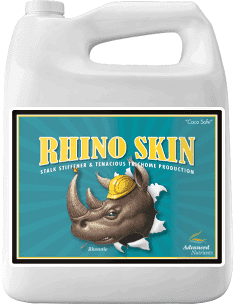

Advanced Nutrients Rhino Skin is a silicon-based plant additive designed to strengthen cell walls, increase trichome production, and free up plant energy for growth and flowering. The 500mL bottle is sized for small to mid-scale hydroponic and soil grows where growers want structural support without committing to a larger volume.
Advanced Nutrients Rhino Skin 500mL Specifications
Key product specifications for Advanced Nutrients Rhino Skin – 500mL, derived from manufacturer product data and supplier records.
| Specification | Value |
|---|---|
| Brand | Advanced Nutrients |
| Product Name | Rhino Skin |
| Volume | 500mL |
| Active Ingredient | Silicon (silicic acid) |
| Product Type | Nutrient additive — structural supplement |
| Category | Growth & Bloom Booster / Additive |
| Shipping Weight | 3.0 lb |
| Supplier SKU | Q415794 |

Why Choose Advanced Nutrients Rhino Skin
Plants growing in controlled, intensive environments are exposed to recurring stressors: pathogen pressure, temperature swings, humidity fluctuations, and physical stress from dense canopies and heavy fruit loads. Managing these stressors normally costs the plant metabolic energy it could otherwise direct toward photosynthesis, cell division, and resin production. Rhino Skin addresses that trade-off by supplying silicon externally so the plant’s own defenses are less taxed.
Silicon absorbed by plants is deposited in cell walls, physically thickening them and reducing the space between cells that pathogens and pests exploit. That structural reinforcement is the core mechanism behind the benefits described in Rhino Skin’s product data. Harder, denser tissue resists wilting and physical stress, which is particularly useful during late flower when bud weight creates stem load and plants are vulnerable to botrytis and other humidity-related pathogens.
The secondary benefit is energy reallocation. When silicon fills the structural role that plants would otherwise use carbohydrates and energy to maintain, those resources can shift toward trichome development, essential oil production, and additional bud mass. Growers using Rhino Skin report that harvests are denser and more resinous relative to untreated crops in the same environment.
- Cell wall fortification: Silicon deposits mortar the spaces between cell walls, hardening plant tissue and supporting stem strength under heavy bud loads.
- Trichome and essential oil increase: Freed metabolic energy is directed toward resin glands, increasing trichome density and the potency of the final harvest.
- Stress defense: Thicker cell walls provide a physical barrier against pathogen entry and reduce damage from heat, humidity, and pest pressure.
- Upright growth habit: Plants treated with Rhino Skin stand straighter and hold heavier buds without stem fatigue, reducing the need for mechanical support.
- Energy redirection: By reducing the metabolic cost of self-defense, plants can concentrate on photosynthesis and flowering functions.
Best Uses for Advanced Nutrients Rhino Skin
Rhino Skin is used across grow and bloom phases in hydroponic, coco, and soil systems. It fits into a supplemental additive stack rather than replacing base nutrients. The following use cases reflect the product’s design intent based on its silicon mechanism and the environments where silicon supplementation delivers the clearest results.
- High-stress hydroponic environments: DWC, NFT, and ebb-and-flow systems that produce rapid growth also expose plants to high metabolic demands. Silicon supplementation in these setups supports the structural integrity of fast-growing tissue that might otherwise be soft and prone to wilting or infection.
- Late-flowering support: As colas bulk up and bud weight increases, stem load rises. Applying Rhino Skin through late flower helps plants support heavier flowers without bending or toppling, and the denser cell walls reduce botrytis risk in humid environments.
- Pathogen-prone or pest-prone rooms: Growers dealing with recurring spider mite, thrip, or powdery mildew pressure can use Rhino Skin as part of a preventive approach. Thicker cell walls are harder for pests to pierce and for fungal spores to penetrate.
- Coco and soilless media: Silicon is not naturally present in coco coir or most inert substrates, so plants grown in these media have no passive silicon uptake. Rhino Skin fills that gap directly, making it especially relevant for coco growers who want structural support similar to what soil-grown plants get from silica minerals.
- Complementary use with root and microbial products: Silicon supplements stack well with root-zone biologicals. When root health is strong and structural integrity is high, plants manage stress from both ends — root uptake efficiency and above-ground resilience. Pairing Rhino Skin with a root inoculant like Advanced Nutrients Tarantula covers both dimensions of plant health.
Compatibility
Rhino Skin is formulated to work across the grow and bloom phases and is compatible with the full Advanced Nutrients base nutrient line, including pH Perfect Sensi, Connoisseur, and Jungle Juice series. It can be used in hydroponic reservoirs, coco coir, and amended soil environments.
Silicon-based additives require specific handling in reservoirs: silicon raises solution pH, so it should be added first to the reservoir before base nutrients, then pH-adjusted after all components are combined. Mixing silicon directly with concentrated phosphorus sources before dilution can cause precipitation, so always dilute in water first.
Rhino Skin is suitable for use in recirculating systems (DWC, RDWC, NFT, ebb-and-flow) and run-to-waste systems (coco, rockwool, soil drip). For growers building out a comprehensive additive program, it pairs well with other stress-response products. Those using organic inputs alongside synthetics should check that the silicon source is compatible with microbial supplements — monosilicic acid forms such as Rhino Skin are generally microbe-compatible at label rates.
If you are also supplementing with a molasses-based carbohydrate product like Earth Juice Hi-Brix Molasses, note that silicon and sugars can be added to the same reservoir without issue at normal use rates — they serve different functions and do not interact negatively.
Usage Guidelines
Rhino Skin is intended for use throughout both the vegetative and flowering phases. The product is applied as a reservoir additive or substrate drench rather than a foliar spray. Because silicon raises solution pH, it should be added to your water before base nutrients and pH-adjusted at the end.
General dosing guidance for silicon-based additives in hydroponic and coco systems falls in the range of 1–5 mL per liter (approximately 4–19 mL per gallon), depending on growth stage and plant demand. Start at the lower end during early vegetative growth and increase toward the upper end during peak flowering when structural demand is greatest. Monitor runoff or reservoir EC to ensure the overall nutrient load remains in the appropriate range for your growth stage — silicon contributes to EC, so factor it into your total dissolved solids target.
For soil growers, Rhino Skin can be applied with regular watering. Because soil already contains silica minerals, silicon supplementation is less critical in living soil environments but remains beneficial in depleted or commercial media soils. Check the Advanced Nutrients feed chart for Rhino Skin to get brand-specific dose rates for your program.
The 500mL bottle is sufficient for multiple feed cycles in a small grow. At a mid-range dose of 2 mL per liter, a 500mL bottle treats approximately 250 liters of nutrient solution, or about 66 gallons — roughly 6–10 reservoir changes in a typical small-to-medium hydroponic setup.
How to Apply Rhino Skin
- Shake the bottle before measuring. Silicon concentrates can settle during storage. Invert and shake for 10–15 seconds before pouring.
- Fill your reservoir or mixing container with plain, pH-neutral water first. Silicon is added to water before other nutrients to avoid precipitation reactions with concentrated nutrient salts.
- Measure Rhino Skin using a calibrated syringe or measuring cup. Use the dose rate from the Advanced Nutrients feed chart for your growth stage. Start at the lower end of the recommended range on first use.
- Add Rhino Skin to the water and mix thoroughly. Allow it to fully disperse before adding base nutrients or other additives.
- Add remaining nutrients in their normal order, then mix the full solution.
- Adjust pH to your target range (5.5–6.5 for hydro/coco, 6.0–7.0 for soil) after all components are combined. Silicon raises pH, so final adjustment is essential.
- Verify EC against your target for the growth stage before delivering to plants.
- Apply with each feed throughout veg and bloom. Rhino Skin is most effective when used consistently rather than as an occasional supplement, as silicon deposition in cell walls is a cumulative process.
For growers also working with a root zone inoculant program such as Advanced Nutrients Tarantula, introduce Rhino Skin on the same schedule — the two products address complementary aspects of plant health and do not interfere with each other at label rates.
Sources & Further Reading
| Weight | 3.0005 lbs |
|---|---|
| Brand | Advanced Nutrients |
Be the first to review “Advanced Nutrients Rhino Skin – 500mL”
Related products


Growth & Bloom Boosters


Growth & Bloom Boosters


Growth & Bloom Boosters


Growth & Bloom Boosters


Growth & Bloom Boosters
General Organics 1gal CaMg+ Calcium Magnesium Supplement (4/CS)

Growth & Bloom Boosters

Growth & Bloom Boosters

Growth & Bloom Boosters
Reviews
There are no reviews yet.