

BioAg VAM 300 Grams (12/CS)


$56.27
BioAg VAM 300 Grams — Quick Specifications
| Specification | Value | Notes |
|---|---|---|
| Product Type | Endomycorrhizal inoculant | Dry powder format |
| Net Weight | 300 g per unit | 12 units per case |
| Fungal Species | 7 endo-associating species | In vivo cultivated |
| Additional Ingredient | Humic acids | Blended into formulation |
| Application Methods | Drip, pivot, at-planting, hydroponic | Jar test before tank mixing |
| Crop Suitability | All crops | Per manufacturer documentation |
| Package Dimensions | 8.0 × 5.0 × 2.0 in | L × W × H |
| Supplier SKU | BAGBA78003 | BFG Supply |
BioAg VAM (Vesicular Arbuscular Mycorrhizae) is a 300-gram dry inoculant containing seven species of endomycorrhizal fungi grown on live roots and blended with humic acids. It is designed for growers who want to improve transplant success, accelerate root colonization, and increase water and nutrient uptake across a wide range of crops — including in hydroponic, drip, and fertigation systems.
BioAg VAM 300 Grams Specifications
Physical and package specifications based on supplier catalog data (BFG Supply, SKU BAGBA78003).
| Specification | Value |
|---|---|
| Product Name | BioAg VAM Endo-Mix 300g |
| Brand | BioAg |
| Net Weight | 300 g (approx. 1.0 lb total package) |
| Fungal Species Count | 7 endo-associating mycorrhizal species |
| Cultivation Method | In vivo (grown on live roots) |
| Additional Active Component | Humic acids |
| Package Dimensions (L × W × H) | 8.0 in × 5.0 in × 2.0 in |
| Case Pack | 12 units per case |
| Supplier SKU | BAGBA78003 (BFG Supply) |
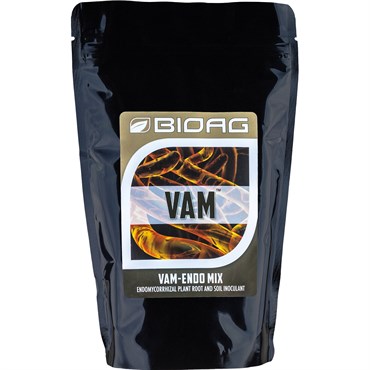
Why Choose BioAg VAM 300 Grams
Mycorrhizal inoculants vary widely in quality, species count, and how the fungi are produced. Here is what distinguishes BioAg VAM from generic mycorrhizal powders:
- In vivo cultivation: The fungi in VAM are grown on live host roots rather than on sterile media. In vivo production yields viable, actively colonizing propagules that have been shown to establish faster than spores grown on artificial substrates.
- Seven-species endo blend: Rather than relying on a single strain, VAM combines seven endo-associating species. A multi-species approach broadens the range of soil temperatures, pH ranges, and crop types the inoculant can colonize effectively.
- Integrated humic acids: The addition of humic acids in the same package provides a root-zone carbon source that supports microbial activity and can improve soil structure. Growers do not need to source and measure a separate humic product for the inoculation step.
- Broad application compatibility: VAM is formulated for drip fertigation, pivot systems, at-planting soil incorporation, and hydroponic systems. It is listed as compatible with most organic and synthetic fertilizers, making it practical across diverse production systems.
- Enhanced transplant success: The product description specifically highlights improved transplant success rates and early establishment, which addresses one of the highest-risk windows in any production cycle — the period between transplant and first true root establishment.
Best Uses for BioAg VAM 300 Grams
VAM is suited to any situation where establishing a strong mycorrhizal network quickly is a priority. The following scenarios reflect the application types described in the canonical product documentation:
- Transplanting seedlings and plugs: Apply VAM directly to the transplant hole or root zone at the time of planting. Introducing the inoculant at the moment roots contact new media maximizes early colonization before transplant stress sets in.
- Drip and pivot fertigation programs: VAM is specifically formulated for injection through drip lines and pivot systems. Growers running large-scale field or greenhouse operations can apply it through their existing irrigation infrastructure without a dedicated hand-application step.
- Hydroponic and recirculating systems: Contrary to the assumption that mycorrhizae require soil, VAM is recommended for hydroponic systems. In these environments it can help bridge the period between transplant and full root development in the solution.
- Crops requiring improved nutrient uptake efficiency: Because mycorrhizal networks extend the effective root surface area, VAM is particularly valuable for phosphorus-limited environments or where growers want to reduce fertilizer input over time. It is described as suitable for all crops, making it applicable from fruiting vegetables to herbs and flowers.
- Tank-mixing with fertilizer programs: VAM can be combined with most organic and synthetic fertilizer programs. For growers already running a beneficial microbe program or a root-zone additive, VAM slots in at the inoculation stage without replacing existing products. A compatibility jar test is recommended before introducing VAM into a new tank mix.
BioAg VAM vs Similar Mycorrhizal Products
The mycorrhizal inoculant category includes a range of products from single-species powders to multi-species consortia. BioAg VAM sits in the multi-species endo-only segment. A few distinctions worth knowing when evaluating alternatives:
Endo-only vs endo + ecto blends: Some products combine both endomycorrhizal and ectomycorrhizal species. Endo fungi colonize the inside of root cells and are effective on the broadest range of crops (grasses, vegetables, herbs, most fruiting crops). Ecto fungi colonize outside the root cell wall and are primarily relevant for conifers and some hardwood trees. If you are growing standard horticultural crops, an endo-only product like VAM is appropriate; ecto species in the blend do not add value for most indoor or greenhouse applications.
In vivo vs in vitro production: Not all mycorrhizal inoculants specify how their spores were produced. In vivo production — growing fungi on live host roots under controlled conditions — is associated with higher propagule viability. Products that do not disclose their production method may use spores produced on synthetic or sterile media, which can have lower establishment rates.
Standalone inoculant vs blended additive: VAM includes humic acids in the same package. Some growers prefer to control humic acid rates separately; others find the bundled format convenient and reduces prep steps. If you are already applying a carbohydrate or carbon source like a molasses-based amendment, consider whether the humic component in VAM overlaps with your existing program.
Size and format: The 300-gram format (12 per case) is sized for commercial operations that apply inoculant repeatedly across multiple crop cycles or large planting areas. Smaller hobby formats exist on the market; the 300g size implies a cost-per-application that favors production growers over small-scale home use.
Compatibility
BioAg VAM is described as compatible with most organic and synthetic fertilizers. However, there are conditions that affect mycorrhizal viability and which any grower running a complex input program should be aware of:
Fertilizer compatibility: High-phosphorus fertilizers can suppress mycorrhizal colonization. Mycorrhizae form mutualistic relationships partly because they improve phosphorus access for the plant; when phosphorus is already abundant in solution, the plant has less biological incentive to maintain the relationship. This does not mean VAM cannot be used alongside phosphorus-containing nutrients, but it does mean that colonization rates may be lower in programs with very high P inputs. This is a general category-level consideration, not a manufacturer restriction specific to BioAg VAM.
Fungicide and biocide interaction: As with any biological inoculant, direct contact with broad-spectrum fungicides, chlorinated water, or UV-sterilized nutrient solutions can reduce viable spore count. A compatibility jar test before tank mixing — as specifically recommended in the product documentation — is the practical way to verify that no input in your program has an antagonistic effect on the fungi before committing to a full application.
Application method: VAM is formulated for drip irrigation, pivot fertigation, at-planting incorporation, and hydroponic systems. It is not described as a foliar product. For foliar-focused programs, VAM serves as a root-zone complement rather than a replacement for any existing foliar regiment.
Usage Guidelines
The following application guidance is derived from the product description. Always verify current label instructions on the package before applying, as formulations can change between production runs.
At planting / transplanting: Apply VAM directly at the root zone when setting transplants or seeding. Place the dry inoculant where it will have immediate root contact. The goal is to have viable propagules present in the rhizosphere as roots begin extending into new media.
Drip and fertigation injection: VAM is listed as suitable for drip or pivot fertigation. When injecting through an irrigation system, prepare a suspension of the measured dose in water and introduce it through your fertilizer injector or proportioner. Follow standard injector protocols for dry-dissolve products. Avoid line filters fine enough to remove the biological material.
Hydroponic applications: In hydroponic systems, introduce VAM at transplant before roots are fully established in the solution. This gives the fungi the opportunity to colonize while roots are still actively forming and extending.
Tank mixing: The manufacturer recommends a compatibility jar test prior to tank mixing. To perform a jar test, combine a small representative sample of the proposed tank mix (all inputs at their intended use concentrations) with the VAM dose in a clean jar. Observe over 24–48 hours for signs of precipitation, off-gassing, or visible biological degradation before scaling to full-volume application.
Fertilizer program integration: VAM can be combined with most organic and synthetic fertilizers. It does not replace a base nutrient program; it is an additive applied to establish and support the mycorrhizal network that improves nutrient uptake efficiency over time.
Sources & Further Reading
BioAg does not maintain a public brand website. Product specifications and features have been compiled from manufacturer documentation and authorized distributor catalogs.
Primary documentation source: BFG Supply distributor catalog, SKU BAGBA78003 — BioAg VAM Endo-Mix 300g.
| Weight | 1 lbs |
|---|---|
| Dimensions | 2 × 5 × 8 in |
| Brand | BioAg |
Be the first to review “BioAg VAM 300 Grams (12/CS)”
Related products

Roots


Roots


Roots

Reviews
There are no reviews yet.