


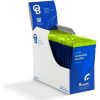
The Bluelab Replacement pH Probe is a double-junction pH sensor designed to replace worn probes on compatible Bluelab and Autogrow monitoring equipment. Its polycarbonate housing, fully waterproof construction, and 2-metre cable make it practical for use in reservoirs, nutrient tanks, and other hard-to-reach grow system locations. The standard BNC connector fits all compatible Bluelab and Autogrow devices without adapters.
Bluelab Replacement pH Probe Specifications
Specifications below are drawn from manufacturer documentation and the canonical product listing. The single attribute value in the source data is weight; remaining specification rows are derived from the product description text.
| Specification | Value |
|---|---|
| Probe Type | Double-junction pH electrode |
| Connector | BNC (standard) |
| Cable Length | 2 metres (approx. 6.6 ft) |
| Housing Material | Polycarbonate |
| Waterproof Rating | Fully waterproof (not water resistant) |
| Minimum Solution EC | 0.2 EC and above |
| Storage Solution | KCl (potassium chloride; storage cap included) |
| Weight | 2.0 lb (approx.) |

Why Choose the Bluelab Replacement pH Probe
Bluelab’s replacement probe is built around double-junction electrode technology, which places a second chamber between the reference electrolyte and the sample solution. This second junction slows contamination of the reference element — the most common cause of pH probe drift and premature failure. The result is a probe that holds its calibration longer and needs less frequent replacement than single-junction designs.
The housing is rated fully waterproof, not merely splash- or water-resistant. That distinction matters in a hydroponic setting where the probe may be fully submerged in a reservoir or nutrient tank for extended periods. The polycarbonate body resists the minor impacts and chemical exposure that are routine in a grow environment.
At 2 metres, the cable is long enough to route from a wall-mounted controller to a reservoir or grow tray without forcing awkward bends or requiring extension cables. The standard BNC connector means the probe seats directly into any compatible Bluelab or Autogrow device — no adapters, no proprietary fittings.
- Double-junction design reduces reference contamination and extends probe lifespan compared to single-junction alternatives.
- Fully waterproof construction — rated for full submersion, not just splash exposure.
- Standard BNC connector provides plug-and-play compatibility with all BNC-equipped Bluelab and Autogrow products.
- 2-metre cable gives enough reach to monitor reservoirs, NFT channels, and DWC buckets from a mounted controller.
- Included KCl storage cap keeps the glass bulb hydrated during storage and transport, extending service life.
- Fast sensor response means the reading stabilises quickly after insertion, reducing time spent waiting for the display to settle.
Best Uses for the Bluelab Replacement pH Probe
This probe is intended as a direct replacement for worn or damaged pH probes on existing Bluelab and Autogrow monitoring equipment. It is not a standalone pH meter — it requires a compatible BNC-equipped device to display readings. The following use cases reflect the product’s design and the minimum EC requirement noted by the manufacturer.
- Recirculating hydroponic systems (DWC, RDWC, NFT, ebb-and-flow): The fully waterproof rating and 2-metre cable make this probe well suited for monitoring pH in large reservoirs and multi-site systems where the controller sits away from the tank. It is effective at the nutrient solution concentrations typical of recirculating grows (0.2 EC minimum).
- Coco and soilless media: Growers using coco coir, rockwool, or perlite can use this probe to spot-check run-off or prepare fertigation solution before feeding. The fast response speed is useful when checking a batch of mixed nutrient solution at the mixing station.
- Commercial and multi-bench operations: The BNC standard and 2-metre cable allow this probe to be used interchangeably across multiple Bluelab meters and controllers in a facility, reducing the number of spares that need to be stocked. The Apera GroStar GS3-E Replacement EC Electrode is a similar concept for growers who also need to replace an EC sensor on a separate meter.
- Monitoring nutrient mix stations: Before adjusting pH in a freshly mixed reservoir, growers can dip this probe to confirm the reading. The polycarbonate housing holds up to repeated use with common pH-up and pH-down solutions.
- Probe replacement programs: Bluelab recommends replacing pH probes on a regular schedule (typically every 12–18 months depending on use frequency and storage practice). This probe fits that replacement cycle for the full range of compatible BNC devices.
Bluelab Replacement pH Probe vs Similar Products
Most pH probes on the market use a single-junction design. In a single-junction probe, the reference electrolyte sits directly behind a single porous junction that interfaces with the sample solution. Over time — and especially in high-EC nutrient solutions — contaminants work their way inward through that junction, shifting the reference potential and causing drift. Single-junction probes can still provide accurate readings when new and well-maintained, but they generally require more frequent recalibration and replacement in active grow environments.
The double-junction design used in this Bluelab probe adds a second chamber filled with an intermediate electrolyte between the inner reference and the outer junction. Contaminants from the sample solution must pass through both junctions to affect the reference, which significantly slows the contamination process. For a grower running a recirculating system continuously — where the probe is submerged for hours or days at a stretch — the double-junction construction translates to a longer period of stable, reliable readings between calibrations.
Generic replacement probes sold by third parties may have BNC connectors that fit Bluelab devices physically, but they may use different glass formulations and reference designs that affect response speed and lifespan. If your current Bluelab meter or controller is performing well, replacing its probe with this manufacturer-matched unit is the lowest-risk path to restoring measurement accuracy.
Growers who also need an EC calibration reference can pair this probe setup with the Apera GroStar EC Calibration Kit (2.77 EC) to maintain both pH and EC accuracy in the same workflow.
Compatibility
The Bluelab Replacement pH Probe uses a standard BNC connector and is designed to work with all Bluelab and Autogrow products that accept a BNC pH probe input. This includes Bluelab pH meters, combination meters, continuous monitors, and Autogrow IntelliDose and MultiGrow controllers, among other BNC-equipped devices in the Bluelab and Autogrow product families.
The probe requires a nutrient solution with an EC of at least 0.2 to produce stable readings. This minimum threshold excludes plain tap water and very dilute solutions. In practice, any standard hydroponic or soil-grown fertigation solution at a normal feed concentration will meet this minimum.
This probe is not intended for use with soil or soilless media directly — it is a liquid-phase probe. For in-media pH readings, a separate spear-style probe designed for that application would be appropriate. When used with aquaponic systems, verify that the bioload-influenced solution EC meets the 0.2 minimum.
Growers running aerated reservoirs should note that dissolved oxygen and air pump turbulence do not affect pH probe accuracy, provided the probe junction remains in contact with the liquid. If you use an Active Aqua air pump in your reservoir for oxygenation, position the probe away from the direct stream of rising bubbles to keep the reading stable.
Usage Guidelines
Proper handling and storage are the two factors that most affect pH probe lifespan. The following guidelines apply to this probe when used in standard hydroponic environments.
Calibration: Calibrate before first use and at regular intervals thereafter. Bluelab recommends using pH 7.0 and pH 4.0 calibration solutions. Never calibrate with tap water. Keep calibration solution volumes small — enough to submerge the tip — and discard used calibration solution after each session to avoid cross-contamination.
Storage between uses: Always replace the KCl storage cap when the probe is not in active use. The potassium chloride solution keeps the glass bulb and reference junction hydrated, which is critical for maintaining probe sensitivity. Storing the probe dry — even for a few hours — can temporarily dehydrate the sensing element and cause slow or erratic readings until the probe rehydrates. If the probe has been stored dry for an extended period, soak the tip in pH 7.0 calibration solution for 30 minutes before use and recalibrate.
Cleaning: Rinse the probe tip with clean water after each use. If deposits form on the glass bulb (mineral scale, biofilm), use a soft cloth dampened with a small amount of dilute HCl or a proprietary probe cleaning solution. Avoid abrasive materials that could scratch the glass sensing element.
Minimum EC requirement: This probe is effective in solutions of 0.2 EC and above. In more dilute solutions, the ionic strength is insufficient to support a stable junction potential, leading to slow response and unreliable readings. If your system runs very dilute (seedling stage, plain water reservoirs), add a small amount of nutrient solution or CalMag to bring EC above the minimum before taking a pH reading.
Temperature: pH readings are temperature-dependent. If your meter or controller includes automatic temperature compensation (ATC), verify it is enabled. Read pH at a consistent solution temperature when comparing results across sessions.
How to Install the Bluelab Replacement pH Probe
Installing a replacement probe follows the same steps regardless of which compatible Bluelab or Autogrow device you are connecting it to. Complete the process with the device powered off to avoid a false reading during insertion.
- Power off the meter or controller. Disconnect it from power before removing the old probe or installing the new one.
- Remove the old probe. Unscrew or unplug the BNC connector from the device. Grasp the connector — not the cable — when disconnecting to avoid stressing the cable crimp.
- Remove the KCl storage cap from the new probe. Set the cap aside; you will need it again whenever the probe is not in use. Do not discard the storage solution inside the cap.
- Rinse the probe tip. Briefly rinse the tip of the new probe with clean water to remove any residual KCl from the exterior of the bulb. Do not wipe the bulb dry.
- Connect the BNC connector. Insert the BNC connector into the device’s probe port and turn it clockwise until it clicks or seats firmly. Do not over-tighten.
- Power on the device. Allow the display to initialise. The reading will be unstable for a few moments while the probe equilibrates.
- Calibrate the probe before use. Perform a two-point calibration using fresh pH 7.0 and pH 4.0 solutions. Follow the calibration procedure for your specific Bluelab or Autogrow device as described in its manual.
- Verify the reading in your nutrient solution. Submerge the probe tip at least 2–3 cm into the solution and allow the reading to stabilise (typically 15–30 seconds). Confirm the reading is within the expected range for your system before relying on it for dosing decisions.
Sources & Further Reading
| Weight | 0.24 lbs |
|---|---|
| Dimensions | 3.6 × 2.3 × 1.3 in |
| Brand | Sunlight Supply |
Be the first to review “Bluelab Replacement pH Probe”
Related products

pH / EC / TDS Meters & Solutions

pH / EC / TDS Meters & Solutions


pH / EC / TDS Meters & Solutions

pH / EC / TDS Meters & Solutions

pH / EC / TDS Meters & Solutions


pH / EC / TDS Meters & Solutions


pH / EC / TDS Meters & Solutions
Hanna GroLine Hydroponic Waterproof Pocket pH/EC/TDS/Temperature Tester

pH / EC / TDS Meters & Solutions
Reviews
There are no reviews yet.