


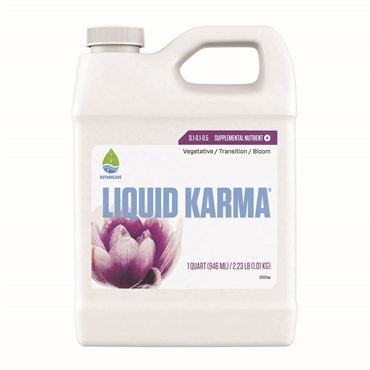
Botanicare 32oz Liquid Karma 0.1-0.1-0.5 (12/CS)


$40.94
Starting cuttings, seedlings, or mother plants and want added root support? Botanicare Liquid Karma is a low-NPK (0.1-0.1-0.5) supplement used alongside your regular feed to support root development and nutrient uptake during early growth. It is a supplement, not a standalone base nutrient; this listing is the 32 oz bottle in a case of 12.
Botanicare Liquid Karma 0.1-0.1-0.5 is a versatile plant supplement designed to be used alongside your regular nutrient program. With a very low NPK profile, it is suited for plant starts, cuttings, seedlings, and mother plants during early vegetative growth, supporting root development and nutrient uptake to encourage healthy foliage, fruit, and bud sites. This listing is for a 32 oz (quart) bottle, sold as a case of 12.
Liquid Karma 0.1-0.1-0.5 Specifications
The following specifications are drawn from the canonical supplier data and physical attributes of the 32 oz bottle.
| Specification | Value |
|---|---|
| Brand | Botanicare |
| Product Name | Liquid Karma |
| NPK Analysis | 0.1-0.1-0.5 |
| Container Size | 32 oz (1 quart) |
| Case Pack | 12 bottles per case |
| Bottle Height | 7.5 in |
| Bottle Width | 2.0 in |
| Bottle Length | 5.2 in |
| Weight (per bottle) | 2.23 lb |
| Product Type | Plant supplement / root additive |
| Supplier SKU | HGC00031 |
Why Choose Liquid Karma 0.1-0.1-0.5
Liquid Karma occupies a specific niche in a plant nutrition program. Because its NPK content is very low — 0.1 nitrogen, 0.1 phosphorus, 0.5 potassium — it is designed to work alongside a primary nutrient solution rather than replace it. This keeps it from interfering with your base feeding program while still contributing to the nutritional environment around the root zone.
- Suited for sensitive plant stages: The low nitrogen and phosphorus content make Liquid Karma a reasonable fit for plant starts, rooting cuttings, seedlings, and mother plants that do not yet need heavy feeding.
- Supports early vegetative growth: According to Botanicare, Liquid Karma is formulated to support vegetative growth during early stages of plant life, when establishing a healthy root system is the primary goal.
- May aid root development and nutrient uptake: The product description states it may enhance the nutritional environment, supporting root development and the plant’s ability to take up nutrients from the primary food source.
- Versatile across plant types: Botanicare positions this as one of the more versatile products in their line, intended for use with plant starts, cuttings, seedlings, and mother plants — covering multiple stages and propagation methods.
- Sold as a case of 12 quart bottles: The 12/CS format suits commercial operations, propagation facilities, and multi-site growers who need consistent supply without frequent reordering.
Best Uses for Liquid Karma 0.1-0.1-0.5
Liquid Karma is categorized as a root additive within the Nutrients & Additives category. Its formulation and Botanicare’s own description point to several specific use cases.
- Propagation and cuttings: The low-NPK profile is well suited to fresh cuttings that need root initiation without the stress of high-nitrogen feeds. Add to the nutrient solution or rooting medium water as directed.
- Seedling establishment: Seedlings in their first one to three weeks are sensitive to salt buildup. Liquid Karma’s minimal NPK allows it to be introduced early in a seedling’s life alongside or instead of a full-strength nutrient mix.
- Mother plant maintenance: Mother plants in vegetative holding require steady, moderate feeding. Using Liquid Karma as a supplement alongside your base vegetative nutrient can help maintain root health and foliar condition over long production cycles.
- General vegetative supplementation: Beyond propagation, Liquid Karma can be run through vegetative stages to support ongoing root development and nutrient uptake as plants mature. Botanicare notes it may aid vibrant foliage, fruit, and bud sites.
- Soil, coco, and hydro systems: As a liquid supplement, it mixes readily into reservoirs, hand-watering solutions, and fertigation lines. It is appropriate across a range of growing media.
Growers who are already running a beneficial microbial root inoculant may find Liquid Karma complements that program by providing a consistent nutritional environment for roots to develop within.
Liquid Karma vs Similar Root Supplement Products
Liquid Karma is a liquid, low-NPK supplement focused on supporting root development and early vegetative growth. Comparing it to other root and additive products helps clarify where it fits in a nutrient program.
Liquid Karma vs. a molasses-based supplement (e.g., Hi-Brix Molasses): Molasses-based additives primarily provide simple carbohydrates to feed beneficial microbial populations in soil and organic media. Liquid Karma is not described as a carbohydrate supplement; it is positioned as a nutritional environment enhancer for root uptake. If you are running an organic or living soil system, a molasses-based product addresses a different mechanism. Liquid Karma may serve a more general supplementation role across media types.
Liquid Karma vs. dry granular root inoculants (e.g., mycorrhizal or crab-meal products): Dry granular products like crab meal provide slow-release organic matter and may support microbial activity, but they require incorporation into soil or a grow medium. Liquid Karma is a ready-to-mix liquid additive, making it appropriate for systems where dry amendments cannot be applied — including DWC, NFT, and coco fertigation. The two are not direct substitutes; they address different aspects of root-zone management.
Liquid Karma (32oz / 12-pack) vs. other Botanicare Liquid Karma sizes: Liquid Karma is also available in other volumes. The 32oz quart format sold as a 12-case is suited to commercial-scale operations requiring consistent per-bottle dosing. Growers with smaller operations may find single bottles in larger volumes more economical per ounce.
Compatibility
Liquid Karma is a liquid concentrate formulated for use as a supplement alongside a primary plant food. It is not a standalone nutrient solution.
- Growing media: Compatible with soil, soilless mixes, coco coir, rockwool, and hydroponic media. As a liquid, it dissolves readily into water-based nutrient solutions and does not require pre-mixing with solid amendments.
- Hydroponic system types: Appropriate for recirculating systems (DWC, RDWC, NFT, ebb-and-flow), drip irrigation, and hand-watering applications. Mix into the reservoir or feed solution before applying.
- Nutrient program pairing: The canonical description states Liquid Karma is intended to be used in combination with your preferred plant food. It is not formulated to replace base A/B nutrients, Cal-Mag supplements, or other core nutrient components. It functions as an additive within an existing program.
- Growth stages: Botanicare’s description focuses on early vegetative stages, plant starts, cuttings, seedlings, and mother plants. Its low NPK makes it less likely to cause nutrient imbalance when added during these stages.
- Root additive programs: If you are already running a dedicated root health product in your reservoir, confirm compatibility by starting with lower doses and monitoring EC and pH before adjusting.
Dosing Guidelines
The canonical product description does not include a specific dose rate per gallon or litre. The following guidelines are general recommendations for liquid plant supplement additives of this type. Consult the label on the bottle and Botanicare’s current feeding charts for confirmed dose rates.
- Measure concentrate carefully using a calibrated syringe, pipette, or measuring cup before adding to your reservoir or feed solution. Do not estimate by sight.
- Add Liquid Karma to pH-adjusted base water or your nutrient solution after mixing your primary base nutrients. Mix thoroughly after each addition before measuring EC.
- Because this product has a very low NPK (0.1-0.1-0.5), it should contribute minimal EC increase. However, monitor reservoir EC before and after addition to confirm there is no unexpected interaction with your existing nutrient stack.
- For plant starts, cuttings, and seedlings, begin at the lower end of the manufacturer’s recommended dose range and increase only if plants show a positive response and no signs of stress.
- For mother plants in ongoing vegetative cycles, apply at a consistent rate per feeding and adjust based on observed plant health and runoff EC readings.
- Shake or stir the bottle gently before measuring each use to ensure the concentrate is uniform.
Note: Always refer to the printed label on the bottle for current, confirmed application rates. Manufacturer recommendations may be updated; the label on the product is the authoritative source for dosing.
How to Use Liquid Karma in Your Nutrient Program
- Start with base water: Begin with reverse osmosis or municipal water pH-adjusted to your target range (typically 5.8–6.2 for hydro and coco, 6.0–6.5 for soil). Do not add Liquid Karma to unadjusted tap water with extreme pH.
- Mix your primary nutrients first: Add your base A and B nutrients and any core supplements (Cal-Mag, etc.) before adding Liquid Karma. This ensures your primary EC and nutrient balance is established before the additive is introduced.
- Measure Liquid Karma concentrate: Using a clean, calibrated syringe or measuring cup, draw the manufacturer-recommended volume for your reservoir or feed volume. Avoid cross-contaminating the concentrate bottle with reservoir water.
- Add to the reservoir or feed solution: Pour the measured concentrate into the mixed nutrient solution. Stir or run your air pump/circulation for at least two minutes to ensure thorough mixing.
- Check EC and pH: Take an EC reading after adding Liquid Karma to confirm the solution is within the target range for your current growth stage. Recheck pH after all additives are mixed, as some concentrates can shift pH slightly.
- Apply to plants: Water or fertgate as normal. For cuttings and seedlings, irrigate at the base or apply to the growing medium. For established plants in recirculating systems, top off the reservoir as needed to maintain the correct solution volume and concentration.
- Monitor plant response: Over the first one to two weeks of use, observe roots and foliage for signs of improvement or stress. Adjust dose if needed based on plant response and runoff EC.
Sources & Further Reading
| Weight | 2.23 lbs |
|---|---|
| Dimensions | 5.2 × 2 × 7.5 in |
| Brand | Botanicare |
Be the first to review “Botanicare 32oz Liquid Karma 0.1-0.1-0.5 (12/CS)”
Related products


Roots


Roots


Roots

Roots
Reviews
There are no reviews yet.