


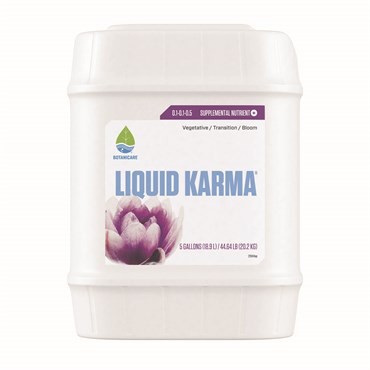
Botanicare 5gal Liquid Karma 0.1-0.1-0.5 (48/PL)


$410.27
Starting cuttings, seedlings, or mother plants and want extra root support? Botanicare Liquid Karma is a low-NPK (0.1-0.1-0.5) supplement used alongside your base feed to support root development and nutrient uptake during early growth. It is a supplement rather than a standalone feed; this listing is the 5-gallon container on a 48-unit pallet.
Botanicare Liquid Karma (0.1-0.1-0.5) is a low-NPK plant supplement designed to support vegetative growth during the early stages of plant life. Used alongside your primary nutrient program, it may enhance the nutritional environment to promote root development, nutrient uptake, and vibrant foliage, fruit, and bud sites. This 5-gallon container is sold as a 48-unit pallet for commercial growers and wholesale buyers.
Liquid Karma Specifications
The table below summarizes the key product specifications derived from the canonical product data and manufacturer labeling. This is the 5-gallon container size, shipped on a 48-unit pallet.
| Specification | Value |
|---|---|
| Brand | Botanicare |
| Product Name | Liquid Karma |
| NPK Analysis | 0.1-0.1-0.5 |
| Container Size | 5 Gallon |
| Pallet Quantity | 48 units per pallet |
| Pallet Weight | 48.6 lb |
| Package Dimensions (L x W x H) | 9.75 in x 11.781 in x 14.969 in |
| Volume (cubic feet) | 0.995 cu ft |
| Supplier SKU | HGC00029 |
| Category | Nutrients & Additives / Additives / Roots |
Why Choose Liquid Karma
Liquid Karma occupies a specific niche in a nutrient program: it is not a primary feed, but rather a supplemental additive that works alongside whatever base nutrient line you already use. Its low nitrogen, phosphorus, and potassium content (0.1-0.1-0.5) is deliberate — the product is formulated to avoid pushing excessive macro-nutrients at growth stages when plants are most sensitive to salt accumulation and over-feeding.
The primary draw for most growers is the breadth of the application window. Because the NPK values are so low, Liquid Karma can be used from the moment a cutting is taken or a seed germinates all the way through the vegetative phase without the risk of nutrient burn that would come from a conventional fertilizer used at the same stage. This makes it one of the more forgiving additives to work with for new growers managing a mixed-age canopy with mother plants, clones, and vegetative transplants all at once.
For commercial operations buying in pallet quantities, the 5-gallon container format provides a practical balance between handling weight and coverage per unit. A single 5-gallon jug goes a long way when used as a supplement rather than a primary feed, and the 48-unit pallet arrangement makes storage and inventory rotation straightforward for larger cultivation facilities.
- Very low NPK (0.1-0.1-0.5): Designed as a supplement that can run alongside any base nutrient program without conflicting macro-nutrient totals significantly.
- Wide application window: Appropriate for plant starts, cuttings, seedlings, and established mother plants — not limited to a single growth phase.
- Root and uptake support: Formulated to aid root development and nutrient uptake, which supports downstream foliage, fruit, and bud site development.
- Versatile across systems: Compatible with soil, coco, and hydroponic growing systems; works with a range of base nutrient programs.
- Pallet format for commercial buyers: The 48-unit pallet minimizes per-unit shipping cost and simplifies bulk purchasing for larger operations.
Best Uses for Liquid Karma
Liquid Karma’s low NPK profile makes it most useful at growth stages where plants need environmental and nutritional support without the risk of over-feeding. The following use cases are derived directly from the manufacturer’s product description.
- Plant starts and seedlings: Young plants are sensitive to high salt concentrations. Liquid Karma’s minimal NPK load means it can be introduced early without disrupting the delicate root environment a seedling needs to establish.
- Cuttings and clones: Cuttings need to develop callus tissue and adventitious roots before they can absorb nutrients efficiently. Using a low-NPK additive like Liquid Karma during propagation may support the root development process without overwhelming immature tissue.
- Mother plant maintenance: Mother plants are held in a perpetual vegetative state and are regularly harvested for cuttings. Keeping their nutritional environment stable without accumulating excess salts over time is a common challenge; a low-NPK supplement can help maintain that balance.
- Vegetative growth phase: During active vegetative growth, Liquid Karma is used in combination with a primary nitrogen-dominant feed to support robust foliage development and strong branching structure going into the transition to flower.
- Root zone conditioning: Growers using Liquid Karma through a recirculating hydroponic system may use it to help condition the root zone and support nutrient uptake efficiency across the canopy.
- Commercial bulk runs: Operations purchasing in pallet quantities who need a reliable, consistent supplement they can apply across multiple growth rooms at once.
Liquid Karma vs Similar Additives
Liquid Karma sits in the root-support and growth-enhancement additive category alongside products like Heavy 16 Roots and Advanced Nutrients Tarantula. The distinction worth understanding before choosing between them is what mechanism each relies on.
Some root-zone additives in this category rely primarily on beneficial microorganisms — bacteria, fungi, or combinations of both — to colonize the root zone and improve nutrient availability through biological activity. Liquid Karma’s 0.1-0.1-0.5 formula, by contrast, works as a supplemental plant food that may enhance the nutritional environment directly. This means it functions differently in sterile hydroponic systems versus living soil or coco media, and it can be used in environments where introducing live microbes would be impractical or undesirable (such as systems that use oxidizing sterilants like hydrogen peroxide).
For growers who prefer to layer their additive stack rather than rely on biologicals, Liquid Karma’s compatibility with a broad range of base nutrient programs makes it a low-risk addition. It is not intended to replace a root inoculant if root-zone biology is part of the cultivation strategy — it is complementary to or independent of that approach depending on the system.
Compatibility
Liquid Karma is formulated as a general-purpose supplement intended to work alongside most plant food programs. The manufacturer’s product description states it is used in combination with your preferred plant food, which means it is not a standalone nutrient product and should not be relied on as a primary feed source.
From a system compatibility standpoint, the low NPK values mean Liquid Karma introduces minimal additional salt load to the reservoir or growing medium. This makes it broadly compatible with:
- Soil and amended growing media: The supplement can be watered in alongside standard soil nutrient programs without materially altering pH or EC in ways that most established soil grows would not handle.
- Coco coir systems: Coco requires careful attention to calcium and magnesium alongside base nutrients; Liquid Karma’s low NPK does not compete with those requirements and can be stacked with a standard coco nutrient line.
- Recirculating and drain-to-waste hydroponic systems: The product can be added to reservoir mix at standard supplement rates. Because it does not contribute significant macro-nutrients, it is unlikely to materially shift EC readings beyond the base feed contribution.
- Botanicare nutrient programs: Liquid Karma is a Botanicare product designed to complement other products in their line, including their primary base nutrients.
- Third-party nutrient programs: Per the manufacturer, Liquid Karma is intended for use with any preferred plant food, indicating it is not program-locked to the Botanicare line.
Growers using carbohydrate-based additives such as molasses products alongside Liquid Karma should monitor EC and adjust the base feed accordingly, as the combined supplement load can approach meaningful levels in high-frequency feed schedules.
Dosing Guidelines
Liquid Karma is a supplement additive with a low NPK profile (0.1-0.1-0.5), which means the dose rate is typically low relative to the total nutrient program volume. Specific per-gallon dose rates are published by Botanicare on their website and in their feed charts. The following general guidance reflects standard practice for this type of low-NPK supplement:
- Shake or stir the concentrate thoroughly before measuring. Liquid concentrates can separate during storage; mixing ensures consistent formula delivery.
- Measure the recommended dose using a calibrated measuring syringe or graduated cup. Consult the Botanicare feed chart for your growth stage and system type for specific ml-per-gallon or ml-per-litre rates.
- Add to your reservoir or feed water after pH-adjusting the base water. Mix into the reservoir after your base nutrients have been added, then re-check pH and adjust to your target range (typically 5.8-6.2 for hydro, 6.0-6.8 for soil).
- Verify EC is within target range for the growth stage before feeding. Because Liquid Karma contributes a small amount to total dissolved solids, account for it when building your total EC target.
- Adjust frequency and dose based on plant response and runoff or drain EC readings. During propagation and early vegetative stages, plants may need less total nutrient input; Liquid Karma’s low NPK makes it suitable to continue at consistent rates across these phases without significant risk of accumulation.
- For mother plants on long vegetative cycles: Regular use of low-NPK supplements at stable rates helps maintain a consistent nutritional environment without building excess salt accumulation over extended maintenance periods.
Refer to Botanicare’s published feed charts at botanicare.com for stage-specific dose rates and compatibility guidance with other products in their line.
Sources & Further Reading
| Weight | 48.6 lbs |
|---|---|
| Dimensions | 9.75 × 11.781 × 14.969 in |
| Brand | Botanicare |
Be the first to review “Botanicare 5gal Liquid Karma 0.1-0.1-0.5 (48/PL)”
Related products

Roots


Roots
Reviews
There are no reviews yet.