


The Netafim 3/4in Low Flow Pressure Regulator handles flow rates from 0.25 to 4.4 GPM and accepts inlet pressures from 30 to 150 PSI, converting high line pressure to a consistent downstream outlet pressure. It is built for drip irrigation, hydroponics, and any application where chemicals or aggressive water may be present. High-strength ABS construction with stainless steel springs and a sealed rolling-diaphragm chamber make this a durable, low-maintenance component for any irrigation line.
Netafim 3/4in Low Flow Pressure Regulator Specifications
The table below lists the confirmed specifications for the 3/4″ low flow model (SKU 31000-001200) as published by Netafim. Other models in the same family — 3/4″ high flow and 1.5″ — are noted for context.
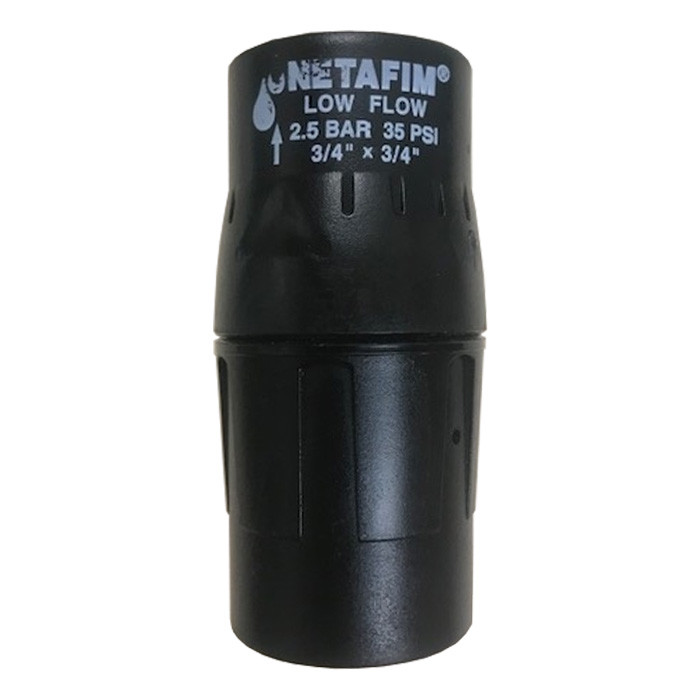
| Specification | Value |
|---|---|
| Model | 3/4″ Low Flow |
| SKU | 31000-001200 |
| Flow Range | 0.25 – 4.4 GPM |
| Operating Inlet Pressure Range | 30 – 150 PSI |
| Maximum Operating Pressure | 145 PSI |
| Connection Type | Female inlet / female outlet |
| Body Material | High-strength ABS (chemical resistant) |
| Spring Material | Stainless steel |
| Regulating Mechanism | Rolling diaphragm, sealed regulating chamber |
| Applications | All irrigation systems |
Family context (same product line, different models):
- 3/4″ High Flow: 4.5 – 17.6 GPM, female inlet / male outlet, includes Sealed Regulating Module and built-in pressure indicator
- 1.5″ Model: 11 – 35 GPM, includes Sealed Regulating Module
- Additional models available up to 175 GPM
Why Choose the Netafim 3/4in Low Flow Pressure Regulator
Pressure regulators are a frequently overlooked component in drip and micro-irrigation setups, but running emitters above their rated pressure causes uneven distribution, accelerated wear, and blown lines. The Netafim 3/4″ low flow regulator is designed specifically for the lower end of irrigation flow — systems running fewer emitters or shorter zones — where standard high-flow regulators can introduce instability at low throughput.
Here is what distinguishes this unit from a basic inline pressure reducer:
- Rolling diaphragm mechanism: Unlike a simple spring-and-seat design, the rolling diaphragm maintains consistent outlet pressure across the full 0.25–4.4 GPM operating range. Pressure response is smooth rather than stepped, which matters when zone demand varies over a watering cycle.
- Sealed regulating chamber: The regulating chamber is sealed from the flow path, so sediment and mineral deposits in the water supply do not interfere with the pressure-sensing element. This reduces drift in outlet pressure over time and lowers maintenance requirements.
- Chemical-resistant ABS body: Many irrigation systems — particularly in hydroponics and commercial horticulture — run nutrient solutions, hydrogen peroxide flushes, or acidified water. The ABS body and stainless steel springs resist degradation in these environments, where standard brass or zinc regulators can corrode or leach unwanted ions.
- Broad inlet pressure acceptance (30–150 PSI): Works with municipal supply, well pumps, and boosted systems without requiring a separate pressure-reducing valve upstream. The unit handles inlet variability that occurs between peak and off-peak hours on shared supply lines.
- Simple female-to-female assembly: The 3/4″ low flow model uses female threads on both ends, fitting directly into standard 3/4″ threaded line assemblies with no adapters. Installation does not require specialized tools or fittings.
Netafim is an Israeli-founded irrigation manufacturer with a long history in precision drip systems for agriculture. Their pressure regulators are field-tested across large-scale commercial operations before being offered in smaller residential and horticultural configurations.
Best Uses for the Netafim 3/4in Low Flow Pressure Regulator
This regulator is sized for lower-flow irrigation zones. If your application falls in the 0.25–4.4 GPM range and you have variable or elevated line pressure, this is where it fits:
- Drip irrigation for small grow zones: A single 3/4″ zone running 8–20 drip emitters at 0.5–2 GPH each will typically stay well within the 4.4 GPM ceiling. Installing a regulator before the emitters protects them from pressure spikes that cause unequal distribution and premature failure.
- Hydroponic nutrient delivery lines: Recirculating and top-feed hydroponic setups that run nutrient solution through smaller diameter tubing benefit from regulated pressure to maintain consistent drip rates across all feed sites. The chemical-resistant construction is specifically appropriate for nutrient solutions. If your system also uses an air pump for oxygenation, an Active Aqua multi-outlet air pump can run alongside this regulator in the same water management setup.
- Fertigation systems with chemical inputs: Commercial and semi-commercial growers who inject fertilizers, pH adjusters, or sanitizers into the line need components that will not corrode or contaminate the solution. The ABS and stainless steel construction of this regulator makes it compatible with typical fertigation chemical loads.
- Point-of-use pressure reduction for sensitive equipment: Some water monitoring instruments and inline filters specify a maximum operating pressure below typical municipal supply. If your supply runs above 80 PSI, placing this regulator upstream of a mesh screen filter or sensitive measurement device protects equipment and maintains accurate readings.
- Low-flow micro-spray and misting zones: Greenhouse misting lines and propagation systems often run at very low flow rates. The 0.25 GPM lower bound means this regulator remains stable even in nearly closed-off zones, unlike high-flow regulators that can chatter or oscillate at the low end of their range.
Netafim 3/4in Low Flow Pressure Regulator vs Similar Products
The Netafim 3/4″ low flow regulator occupies a specific niche: chemical-resistant, rolling-diaphragm construction for low-flow irrigation lines (under 4.4 GPM). Understanding where it sits relative to other pressure management options helps you confirm whether it is the right fit.
vs. Standard brass pressure reducers: Brass inline pressure reducers are common in residential plumbing and garden irrigation but are designed for potable water. They are not rated for chemical irrigation inputs and can corrode or leach copper and zinc into solution — a problem in any hydroponic or organic growing context. The Netafim ABS body is inert to the fertilizers and pH adjusters typically used in controlled growing environments.
vs. Netafim 3/4″ high flow model (4.5–17.6 GPM): The high flow model uses a female inlet / male outlet connection and is suited to larger zones with more emitters. It also includes a built-in indicator that shows when proper outlet pressure is achieved, and a Sealed Regulating Module is available as an option. If your zone flow exceeds 4.4 GPM, the high flow model is the correct choice. If you’re running a smaller zone or a single drip line, the low flow unit provides better stability at lower throughput.
vs. no regulator (relying on line pressure): Many growers skip the pressure regulator to reduce hardware cost. In practice, unregulated drip systems running above 30–40 PSI at the emitter often show uneven distribution across a zone — emitters closest to the supply deliver more than those at the end of the line. Adding a regulator at the zone inlet is one of the lowest-cost interventions for improving distribution uniformity.
Compatibility & Operating Range
The Netafim 3/4″ low flow pressure regulator is compatible with standard 3/4″ NPT threaded irrigation lines. Both inlet and outlet are female-threaded, so it fits directly into 3/4″ male-threaded fittings and line assemblies without adapters.
Pressure: Inlet pressure must be at least 30 PSI for the regulator to function correctly. Below 30 PSI, there is insufficient differential for the rolling diaphragm to regulate. The regulator accepts up to 150 PSI at the inlet. Maximum operating pressure is rated at 145 PSI — do not exceed this on the inlet side.
Flow: The operating flow range is 0.25 – 4.4 GPM. Outside this range — particularly below 0.25 GPM — the regulator may not hold stable outlet pressure. If your system runs above 4.4 GPM at this zone, select the Netafim 3/4″ high flow model (4.5–17.6 GPM) instead.
Water chemistry: The ABS body and stainless steel springs are compatible with chemically treated irrigation water, including nutrient solutions, hydrogen peroxide rinses, and pH-adjusted water. This makes it suitable for hydroponics, fertigation, and greenhouse applications where aggressive water chemistry is routine.
System types: Per Netafim’s published application scope, this regulator is rated for use in all irrigation systems — drip, micro-spray, misting, and subsurface. It is not a backflow prevention device and does not substitute for a check valve where backflow prevention is required.
If your system requires precise water quality monitoring downstream, pairing this regulator with calibrated EC measurement tools — such as an EC calibration kit — ensures your instruments are reading accurately after the pressure reduction point.
Usage Guidelines
The Netafim 3/4″ low flow pressure regulator is a passive device — it requires no power, no programming, and no adjustment after installation. The following guidelines cover proper installation and routine checks:
Orientation: Install with water flowing in the correct direction. The regulator body is marked with an arrow indicating flow direction. Installing it backwards will block or restrict flow without providing pressure regulation.
Placement in the line: Position the regulator at the zone inlet, after any filter and before drip emitters or micro-spray heads. Placing it after emitters provides no benefit. For best results, install a filter upstream of the regulator to prevent particulate from reaching the diaphragm chamber. A 150–200 mesh screen filter is recommended for drip systems.
Inlet pressure verification: Before commissioning, verify that your supply pressure at the zone inlet falls within the 30–150 PSI operating range. A simple inline pressure gauge installed at the supply side confirms this. If supply pressure is below 30 PSI, the regulator will not regulate — it will pass flow without reducing pressure.
Flow rate check: Calculate the total flow demand for the zone by summing the rated flow of all emitters. If the sum exceeds 4.4 GPM, this low flow model is undersized and the high flow model (4.5–17.6 GPM) should be used instead.
Routine inspection: Inspect the regulator body and connections for drips or seeping at the threads after the first pressurization. Re-apply thread seal tape (PTFE) if needed. Under normal operating conditions with clean filtered water, the unit requires no ongoing maintenance. In chemically treated systems, flush the line with fresh water at the end of each season before storage.
Winterization: If installed in an outdoor system subject to freezing, drain the line fully before temperatures drop below 32°F. ABS is not rated for freeze-thaw cycling under pressure. Remove the regulator and store it indoors if prolonged freezing is expected.
How to Install the Netafim 3/4in Pressure Regulator
- Shut off supply water and relieve pressure in the line before beginning. Open a downstream emitter or valve to confirm pressure has dropped to zero.
- Identify the flow direction arrow on the regulator body. The inlet (where supply water enters) connects to the upstream side; the outlet connects toward your emitters or drip tubing.
- Wrap male threads on both the upstream and downstream fittings with 2–3 layers of PTFE (thread seal) tape, wrapping in the direction of the thread helix.
- Thread the regulator onto the upstream male fitting by hand until snug, then tighten an additional 1–2 turns with a wrench. Avoid over-tightening — ABS threads can crack under excessive torque.
- Connect the downstream fitting (the emitter line or distribution tubing) to the outlet port using the same PTFE-tape method.
- Slowly restore water supply and bring pressure up gradually. Check all threaded joints for leaks. Allow the regulator to settle for 60 seconds at operating pressure before inspecting downstream emitters.
- Verify downstream pressure if you have a gauge port or a pressure gauge downstream. The regulator will hold outlet pressure within its rated range; if downstream pressure appears abnormally high or low, confirm that inlet pressure is within the 30–150 PSI operating range and that zone flow does not exceed 4.4 GPM.
Sources & Further Reading
| Weight | 1 lbs |
|---|---|
| Dimensions | 4 × 4 × 1.5 in |
Be the first to review “Netafim 3/4in Low Flow Pressure Regulator 0.25-4.4GPM”
Related products

Water & Air Pumps

Water & Air Pumps


Hydroponic Systems & Water Management


Water & Air Pumps

Water & Air Pumps
Netafim 17mm Combination Tee 2-Way Insert x 3/4in FPT (10pcs/Bag)

Water & Air Pumps


Water & Air Pumps


Water & Air Pumps
EcoPlus Eco Air 4 Air Pump Four Outlet 6.5 Watt 253 GPH (16/CS)
Reviews
There are no reviews yet.