


The Netafim Manual Disc Filter in 1.5-inch MPT x MPT with 140-mesh filtration is designed for inline irrigation water filtration across residential, commercial, municipal, and institutional applications. Stacked polypropylene disc rings form a cylindrical filter element that compresses under pressure to trap debris while passing clean water through to the irrigation system. Rated to 140 PSI with a flow range of 10–35 GPM, the filter operates as a stand-alone unit or as part of a modular filter battery.
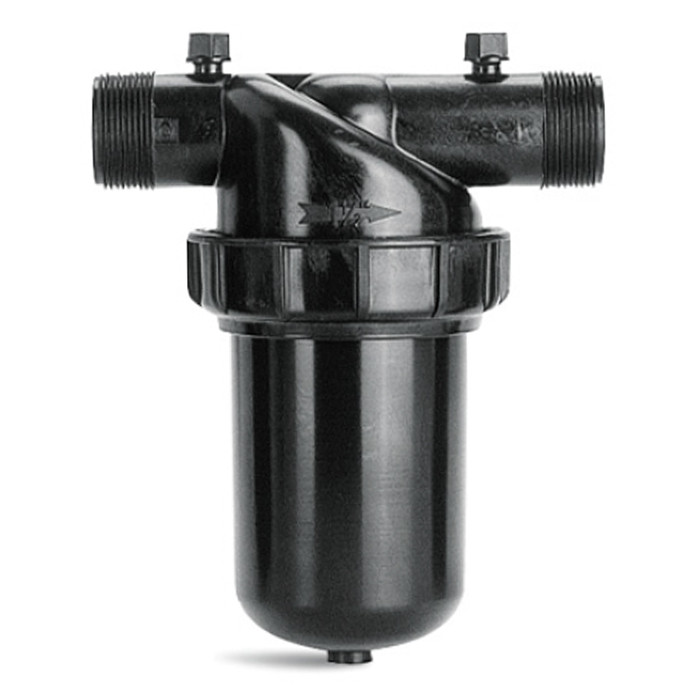
Netafim Manual Disc Filter 1.5in Specifications
All specifications are drawn from Netafim manufacturer documentation for SKU 00135-000110 (1.5-inch MPT x MPT, 140-mesh, 10–35 GPM).
| Specification | Value |
|---|---|
| Connection Size | 1.5 in MPT x MPT (male pipe thread both ends) |
| Mesh / Filtration Rating | 140 Mesh (100 micron nominal) |
| Flow Range | 10–35 GPM |
| Maximum Operating Pressure | 140 PSI |
| Filter Body Material | Reinforced Polyamide |
| Filter Cover Material | Reinforced Polyamide |
| Disc Ring Material | Polypropylene |
| O-Ring Material | EPDM Rubber |
| Clamp Material | Stainless Steel |
| Supplier SKU | 00135-000110 |
Why Choose the Netafim Manual Disc Filter
Disc filtration is well-suited to irrigation systems where particulate matter — sand, sediment, organic debris — is the primary contamination risk. Here is what distinguishes the Netafim manual disc filter design from basic mesh or screen alternatives:
- Pressure-activated compression for tighter filtration under load. As inlet pressure rises, the polypropylene disc rings compress together more tightly, reducing the effective pore size under demand. Filtration quality does not degrade during peak-flow events — it improves.
- Reinforced polyamide housing rated to 140 PSI. The filter body and cover are both molded from glass-fiber-reinforced polyamide, a material that resists deformation under sustained pressure and is chemically compatible with common nutrient solutions and irrigation water treatments.
- EPDM O-rings resist a wide range of water chemistries. EPDM rubber maintains its seal in chlorinated water, lightly acidic or alkaline solutions, and outdoor temperature ranges typical of greenhouse and field installations.
- Stainless steel clamps secure the filter element without corrosion risk. Hardware that contacts moisture is stainless, avoiding the rust contamination that can occur with zinc or painted mild-steel fasteners in wet environments.
- Modular design allows filter batteries at higher flow rates. Individual units can be manifolded in parallel to serve system flow rates above the single-unit 35 GPM ceiling, without moving to a larger or more expensive filter housing.
- Minimal maintenance design. The disc stack is backwashed or disassembled for cleaning when pressure differential indicates clogging. There are no expendable cartridges — the polypropylene disc rings are rinsed and reused.
Best Uses for the Netafim Manual Disc Filter
This filter is appropriate wherever an inline particulate barrier is needed between a water supply and a drip, micro-irrigation, or recirculating hydroponic system. Common deployment scenarios include:
- Drip irrigation in commercial greenhouse and nursery operations. Emitters and drip stakes have small orifices that clog readily. A 140-mesh filter upstream of the drip manifold removes particles large enough to cause emitter failure, extending emitter service life and reducing labor for clearing blockages.
- Residential garden irrigation fed from a well or surface water source. Well water often carries fine sand; surface water sources carry organic matter. Either warrants inline filtration before distribution tubing. The 10 GPM minimum flow rate is appropriate for moderate residential pressure and zone sizes.
- Pre-filter for reverse osmosis systems in hydroponic facilities. RO membranes are sensitive to suspended solids. A disc filter installed upstream of an RO system reduces the sediment load on the membrane, extending membrane service intervals.
- Municipal and institutional irrigation infrastructure. Larger-scale landscape irrigation systems served by municipal supply can still carry pipe scale, sediment, and biofilm fragments. This filter provides a serviceable inline barrier without requiring a bypass valve during normal operation.
- Modular filter battery in high-flow field irrigation systems. Multiple units manifolded in parallel scale total flow capacity without requiring a larger single filter, which is useful when space or pressure constraints limit filter sizing.
Netafim Manual Disc Filter vs Similar Inline Screen Filters
Inline irrigation filters are available in two main mechanical types: disc filters and mesh/screen filters. Understanding the difference helps with product selection.
Disc filters vs mesh screen filters: A mesh screen filter — like the Dilution Solutions 1.5-inch 200-mesh screen filter — uses a single flat or cylindrical screen as the filter element. The screen is effective and easy to visually inspect, but it filters at a fixed pore size regardless of flow rate or pressure. A disc filter’s stacked-ring element compresses more tightly as pressure increases, so the effective filtration becomes finer under higher-demand conditions. Disc filters also offer a larger total surface area for their housing footprint, which extends service intervals between cleanings at equivalent particle loads.
140-mesh vs 200-mesh: This Netafim unit is rated 140 mesh (approximately 100 micron). A 200-mesh screen passes particles down to roughly 74 micron. For standard drip emitters, 140 mesh is typically sufficient. For micro-emitters or foggers with very fine orifices, 200 mesh provides an additional margin. The coarser 140-mesh rating also produces lower pressure drop across the filter at equivalent flow rates.
Manual vs self-cleaning disc filters: Netafim also manufactures self-cleaning (automatic backwash) disc filter systems for installations where manual service is impractical. The manual disc filter is lower in initial cost and appropriate for installations with accessible maintenance access. If the filter serves a remote or automated system without regular operator visits, a self-cleaning configuration warrants consideration.
Compatibility & Operating Range
The Netafim 1.5-inch MPT disc filter is compatible with standard 1.5-inch male NPT/BSP irrigation and plumbing fittings. Both inlet and outlet threads are male pipe thread, so the filter is installed between female-threaded fittings or valve bodies in the supply line.
Pressure range: Rated to 140 PSI maximum. Most residential and commercial irrigation systems operate at 30–80 PSI, well within this limit. High-pressure commercial systems approaching or exceeding 100 PSI should verify that all downstream fittings and tubing are also rated accordingly.
Flow range: 10–35 GPM. At flows below 10 GPM, disc filters in this class may not produce sufficient inlet pressure to fully compress the disc stack, potentially allowing larger particles to pass. At flows above 35 GPM, pressure drop across a single unit becomes excessive; parallel manifolding is recommended.
Chemical compatibility: Reinforced polyamide, polypropylene, EPDM rubber, and stainless steel are each compatible with water containing dissolved fertilizers and standard pH-adjusting agents (citric acid, phosphoric acid, potassium hydroxide) at concentrations typical in irrigation and hydroponic use. Concentrated organic solvents, strong oxidizers above typical sanitizing concentrations, or highly chlorinated water at elevated temperature may degrade EPDM over time; consult Netafim compatibility documentation for specific chemistries.
Temperature range: Polyamide and polypropylene components are rated for typical outdoor and greenhouse ambient temperatures. Prolonged exposure to water above 50°C (122°F) or UV without covering is outside the intended operating range.
Usage Guidelines
Disc filters require minimal routine maintenance but do need periodic cleaning when the pressure differential across the filter indicates the disc stack has accumulated enough debris to restrict flow. The following guidelines apply to standard manual disc filter operation:
- Monitor pressure differential. Install pressure gauges upstream and downstream of the filter. A pressure drop greater than 5–7 PSI across a clean filter at nominal flow indicates the disc stack needs cleaning. In practice, many operators schedule cleaning at the start and end of each irrigation season, or more frequently when source water carries heavy particulate loads.
- Do not operate below the minimum flow rate. The 10 GPM minimum is not an absolute cutoff, but operating at very low flow rates reduces the compression force on the disc stack and may allow undersized particles to pass. If your zone flow is consistently below 10 GPM, consider a smaller-diameter filter.
- Flush the supply line before connecting the filter. New installations often introduce pipe scale, thread compound residue, and construction debris into the line. Flush the upstream piping before closing the filter housing to avoid immediately loading the disc stack with installation debris.
- Check O-ring condition at each cleaning interval. EPDM O-rings have long service life but should be inspected for cracking or deformation when the filter is opened. Replacement O-rings are available from Netafim and authorized distributors.
How to Install the Netafim Manual Disc Filter
Installation is straightforward for anyone familiar with threaded irrigation plumbing. The filter is designed for inline installation in a horizontal or vertical supply line.
- Shut off the water supply upstream of the installation point and depressurize the line by opening a downstream valve or faucet.
- Cut or disconnect the supply line at the installation point, leaving enough clearance on both sides to thread the filter body in-line. Ensure the section of line is clean and free of burrs at cut ends.
- Apply thread sealant (PTFE tape or pipe thread compound rated for potable water or irrigation use) to all male threads. Wrap PTFE tape clockwise viewed from the thread end, 2–3 layers, ensuring no tape extends past the first thread where it could enter the filter.
- Thread the upstream female fitting onto the filter inlet and the downstream female fitting onto the filter outlet. Hand-tighten, then use appropriate wrenches to snug (do not over-torque polyamide fittings — firm hand-tight plus approximately one turn with a wrench is sufficient).
- Verify filter orientation. The filter must be installed with flow in the correct direction. Check for a flow-direction arrow molded into the filter body. Reverse installation will not damage the filter but will sharply reduce its effectiveness.
- Restore water supply slowly and check all connections for leaks. Fully pressurize the system and recheck after 5 minutes. Correct any weeping joints before returning the system to normal operation.
- Record the baseline pressure differential across the filter at nominal system flow. This reading — with a clean disc stack — is your reference for determining when cleaning is needed.
Sources & Further Reading
| Weight | 4 lbs |
|---|---|
| Dimensions | 7 × 12 × 7 in |
Be the first to review “Netafim Manual Disc Filter 1.5in MPT x MPT 140 Mesh 10-35GPM”
Related products

Filtration & RO Units


Filtration & RO Units
Hydro-Logic ARCS Stage 2 Heavy Metal Reduction Cartridge (4/CS)

Filtration & RO Units
Hydro-Logic Pressure Gauge Kit 1/2Inches QC Tee liquid filled for Evolution RO

Filtration & RO Units


Filtration & RO Units
Hydro-Logic Pre-Evolution Sediment Filter Pleated/ Cleanable (18/CS)


Filtration & RO Units
Hydro-Logic HYDROID Compact Commercial Reverse Osmosis System (1/PL)


Filtration & RO Units


Filtration & RO Units
Reviews
There are no reviews yet.