


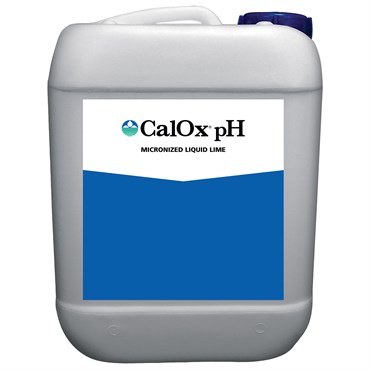
BioSafe CalOx pH is a flowable, micronized calcium carbonate suspension designed to raise and stabilize soil pH immediately after application, with effects lasting over 35 days. Formulated with more than 70% active ingredient and an ultra-fine particle size that passes through drip emitters without clogging, it is built for direct injection or drench use in greenhouse, horticulture, nursery, landscape, and turf operations. This 2.5-gallon container supplies both calcium and magnesium to support plant health alongside pH correction.
CalOx pH Specifications
The following table covers the key physical and chemical characteristics of BioSafe CalOx pH in the 2.5-gallon size, drawn from the manufacturer description and distributor data sheet.
| Specification | Value |
|---|---|
| Brand | BioSafe Systems |
| Product | CalOx pH — Micronized Lime Solution |
| Container Size | 2.5 Gallons (9.46 L) |
| Active Ingredient | Micronized Calcium Carbonate (>70%) |
| Formulation Type | Flowable lime suspension |
| Nutrients Supplied | Calcium and Magnesium |
| pH Effect Duration | Raises and stabilizes soil pH for 35+ days |
| Application Method | Drench or direct injection; emitter-safe |
| Odor | Odorless |
| Tank Mix Compatibility | Can be used alone or in tank mixes |
| Shipping Weight | 25 lb |
| Supplier SKU | BSF201125 |
Why Choose CalOx pH
CalOx pH addresses one of the more persistent challenges in greenhouse and nursery production: keeping root-zone pH in range without disrupting irrigation infrastructure or creating excessive labor overhead. Here is what distinguishes it from granular lime and conventional pH-up products:
- High active-ingredient loading (>70%): Most flowable lime products carry 30–50% active ingredient. CalOx pH’s micronized formulation delivers a higher concentration of calcium carbonate per unit volume, meaning smaller application volumes to achieve the same pH shift.
- Emitter-safe particle size: The ultra-fine grind passes through standard drip emitters and injection ports without bridging or clogging, allowing it to be injected directly into existing irrigation lines — no separate hand-watering runs required.
- Extended pH stability (35+ days): Unlike liquid acid or base products that act transiently, the calcium carbonate buffer persists in the root zone and continues to resist pH drop for over 35 days per application, reducing the frequency of corrective interventions.
- Dual nutrient benefit: Beyond pH adjustment, the calcium carbonate supplies calcium and magnesium — two secondary macronutrients frequently deficient in high-production media — so correcting pH also contributes to the nutrient baseline.
- Odorless and tank-mix compatible: The product has no measurable odor, making it suitable for enclosed greenhouse environments, and it can be combined with other soluble inputs in a single tank pass, simplifying application logistics.
Best Uses for CalOx pH
CalOx pH is designed for professional-scale pH management in production environments where granular lime application is impractical or where irrigation-line injection is preferred. The following are the primary application contexts described by the manufacturer:
- Greenhouse and controlled-environment production: Injectability through drip systems makes CalOx pH well suited to bench and container crops in glasshouses where manual top-dressing with lime is slow and inconsistent. Apply as a scheduled drench to maintain pH in soilless and peat-based substrates.
- Nursery container stock: Container media acidifies over a growing season through irrigation water, fertilizer inputs, and microbial activity. CalOx pH can be injected through the fertigation system at regular intervals to counteract acidification and protect root health in woody and herbaceous stock.
- Horticulture and specialty crop production: Crops with narrow pH windows — such as many fruiting vegetables and herbs grown in coco or peat — benefit from the buffering persistence of calcium carbonate. A single application provides over a month of stabilized pH, reducing the need for frequent monitoring corrections. Growers using supplements like PureCrop1 (2.5 gal) alongside a pH management program will find CalOx pH integrates cleanly into existing fertigation schedules.
- Landscape and turf renovation: For acidic soils in lawn or landscape applications, CalOx pH’s flowable form allows broadcast sprayer or injection application, distributing lime evenly across large areas faster than pelletized lime spread. The micronized particle size also acts faster than standard agricultural lime.
- Soils with persistent low pH or high acid load: Operations sourcing water with low alkalinity, or using high-ammoniacal fertilizer programs that push soil pH down, can use CalOx pH as a proactive buffer rather than a reactive correction.
CalOx pH vs Conventional Agricultural Lime
CalOx pH occupies a different position from both dry granular lime and standard liquid pH-up products (typically potassium hydroxide or sodium bicarbonate solutions). Understanding the differences helps determine whether it is the right input for a given system.
Versus granular or pelletized lime: Granular ag lime requires physical incorporation or topdressing and reacts slowly because particle surface area is low. CalOx pH’s micronized suspension has a vastly larger reactive surface area, meaning pH response begins within days rather than weeks. It is also injectable, which granular products cannot be. The trade-off is cost per unit of calcium carbonate — granular lime is cheaper per pound of CaCO₃ for large outdoor field applications where slow release is acceptable.
Versus potassium hydroxide (KOH) pH-up: KOH-based pH-up products raise pH instantly and transiently. They do not buffer — once the alkalinity is consumed by acidic media or irrigation water, pH drops again. CalOx pH provides a sustained buffer rather than a point-in-time correction. KOH also contributes potassium load, which can push K:Ca ratios out of balance if used repeatedly; CalOx pH contributes calcium and magnesium instead, which are typically welcome in high-production substrates.
Versus hydrated lime (calcium hydroxide): Calcium hydroxide is more caustic and raises pH more aggressively, but is harder to handle safely and can overshoot pH targets in sensitive crops. CalOx pH (calcium carbonate) is less caustic and buffers rather than spikes, giving growers more forgiving dosing characteristics. Growers managing complex nutrient programs alongside pH correction — for example, those incorporating Advanced Nutrients Tarantula microbial inoculants that prefer specific pH windows — will generally find calcium carbonate the safer choice to avoid pH overshoot.
Compatibility
CalOx pH is described as compatible with tank mixes and can be used alongside other soluble inputs. Key compatibility considerations based on the manufacturer description:
- Irrigation system types: Suitable for drip, micro-spray, and overhead injection systems. The ultra-fine particle size is specifically formulated to avoid clogging emitters, which is the primary mechanical compatibility concern with flowable lime products.
- Substrate types: Intended for soil, soilless media (peat, coco, bark-based mixes), and turf rootzones. Its buffering action relies on the calcium carbonate interacting with soil or media acids, so it is most effective in substrate-based systems rather than recirculating hydroponic reservoirs where carbonate alkalinity would affect solution chemistry differently.
- Tank mixes: The manufacturer states it is usable alone or in tank mixes. As with any alkaline input, it should be pre-mixed and tested in small batch before combining with acid-reaction inputs (e.g., phosphoric acid-based products) in the same tank, as these will react and neutralize each other.
- Nutrient programs: Compatible with most conventional and organic nutrient programs applied as separate drench passes or in diluted tank mixes. Growers running organic supplement stacks — for instance those using Earth Juice Hi-Brix Molasses as a carbohydrate amendment — should apply CalOx pH as a dedicated drench or time it before the organic inputs to avoid pH interactions in the spray tank.
- Application equipment: Compatible with standard injection proportioners (e.g., Dosatron), venturi injectors, and pump-driven fertigation systems. Shake or stir concentrate before each use to resuspend settled solids.
Usage Guidelines
The manufacturer description establishes CalOx pH as a drench or direct-injection product. The following guidelines are derived from the manufacturer description; consult the current product label for specific rates, as label rates are the legal standard for application.
- Determine target pH: Before applying, measure current substrate or soil pH using a calibrated pH meter or soil test. CalOx pH is designed to raise and stabilize pH; the volume applied will depend on how far below target the current pH sits and the buffering capacity of the substrate.
- Mix thoroughly before use: As a suspension, calcium carbonate will settle during storage. Shake the container or stir the bulk supply thoroughly until uniform before measuring the dose. A settled product applied without mixing will deliver an inconsistent concentration.
- Apply as drench or via injection: Dilute per label rate in clean water and apply evenly as a substrate drench, or pre-dilute and inject through the fertigation system at the label-specified ratio. Ensure uniform coverage across the root zone.
- Re-test pH after 3–5 days: The micronized calcium carbonate reacts within days. Re-test substrate pH after 3–5 days to confirm the target range has been reached before scheduling the next application.
- Re-application interval: The manufacturer states pH stabilization persists for over 35 days. Schedule re-application based on monitoring results and crop cycle, not on a fixed calendar interval.
- Microbial activity benefit: The manufacturer notes that balanced soil pH promotes optimal microbial activity. If the operation uses biological inoculants or organic matter-based inputs, pH correction to the appropriate range will support microbial efficacy.
How to Apply CalOx pH
- Measure baseline pH: Use a calibrated substrate pH meter or saturated paste extract to determine current root-zone pH before the first application. Record the reading for comparison after treatment.
- Shake or agitate the container: CalOx pH is a suspension. Shake the 2.5-gallon container vigorously for 30–60 seconds, or stir bulk supply tanks for 2–3 minutes, before drawing product for measurement.
- Measure the dose: Using a calibrated measuring cup or syringe, measure the label-specified volume of CalOx pH concentrate. Do not estimate by eye — calcium carbonate is a buffering input and dose accuracy affects the final pH outcome.
- Dilute in clean water: Add the measured concentrate to your application water or fertigation tank. Mix well. If tank-mixing with other inputs, add CalOx pH last and verify no visible reaction (foaming or heat) with the other components before proceeding.
- Apply evenly to root zone: Apply as a drench, distributing uniformly across the container, bed, or turf area. If using a drip or micro-irrigation system, inject at the label rate through a compatible proportioner.
- Flush emitters if needed: After an injection application, run clean water through the system briefly to clear any residual from emitter orifices, particularly in hard-water areas where calcium carbonate could precipitate with carbonate-rich water.
- Monitor and record: Re-test pH 3–5 days post-application and record results. Adjust subsequent application rates up or down based on actual pH response relative to target.
Sources & Further Reading
- BioSafe Systems — Official Manufacturer Website — product information, technical documentation, and label resources for CalOx pH and the full BioSafe product line.
| Weight | 25 lbs |
|---|---|
| Brand | Biosafe |
Be the first to review “Biosafe CalOx pH 2.5Gl”
Related products

Nutrients & Additives

Nutrients & Additives

Nutrients & Additives


Calibration / Cleaning Solutions

Nutrients & Additives

Nutrients & Additives

Calibration / Cleaning Solutions


Calibration / Cleaning Solutions
Reviews
There are no reviews yet.