
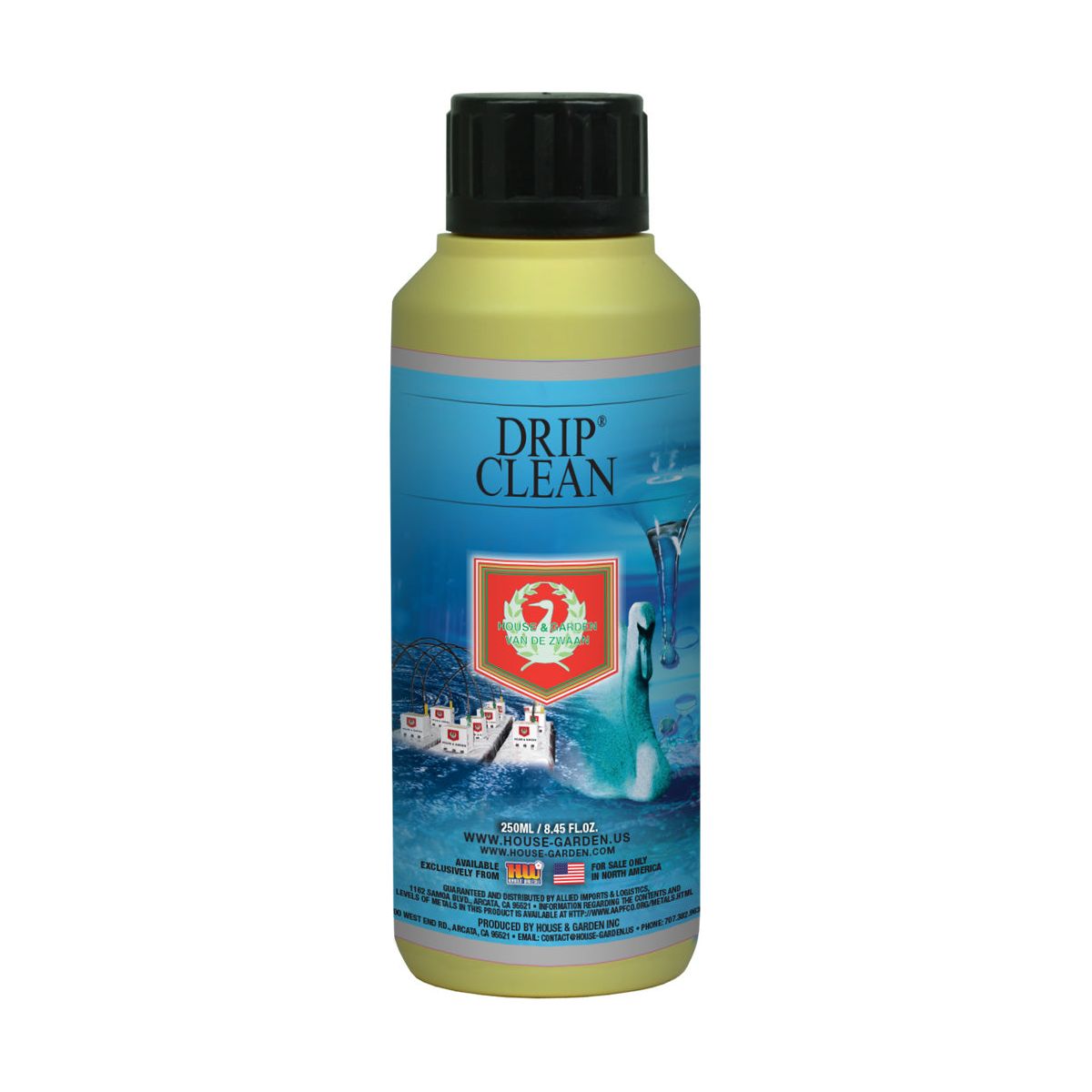
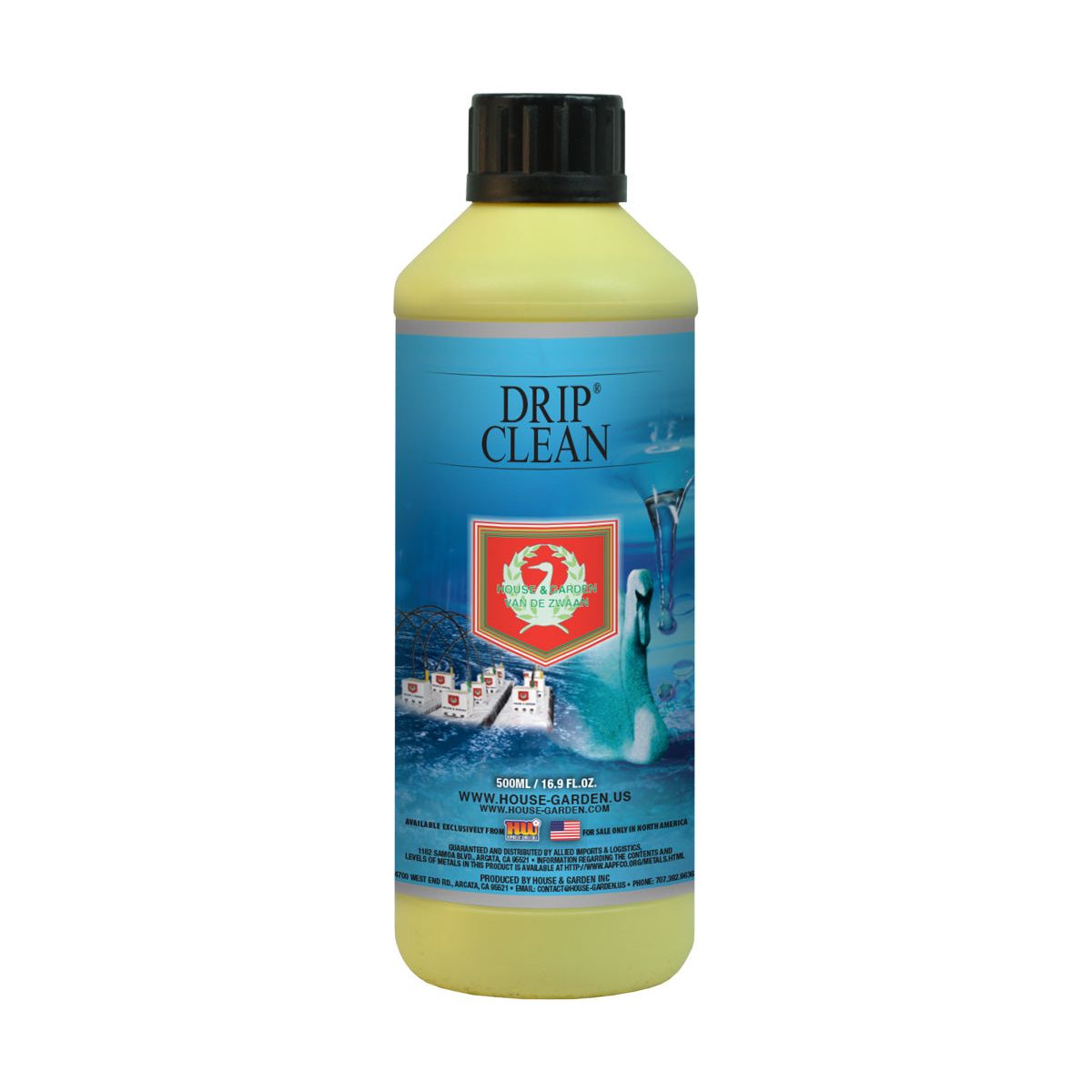
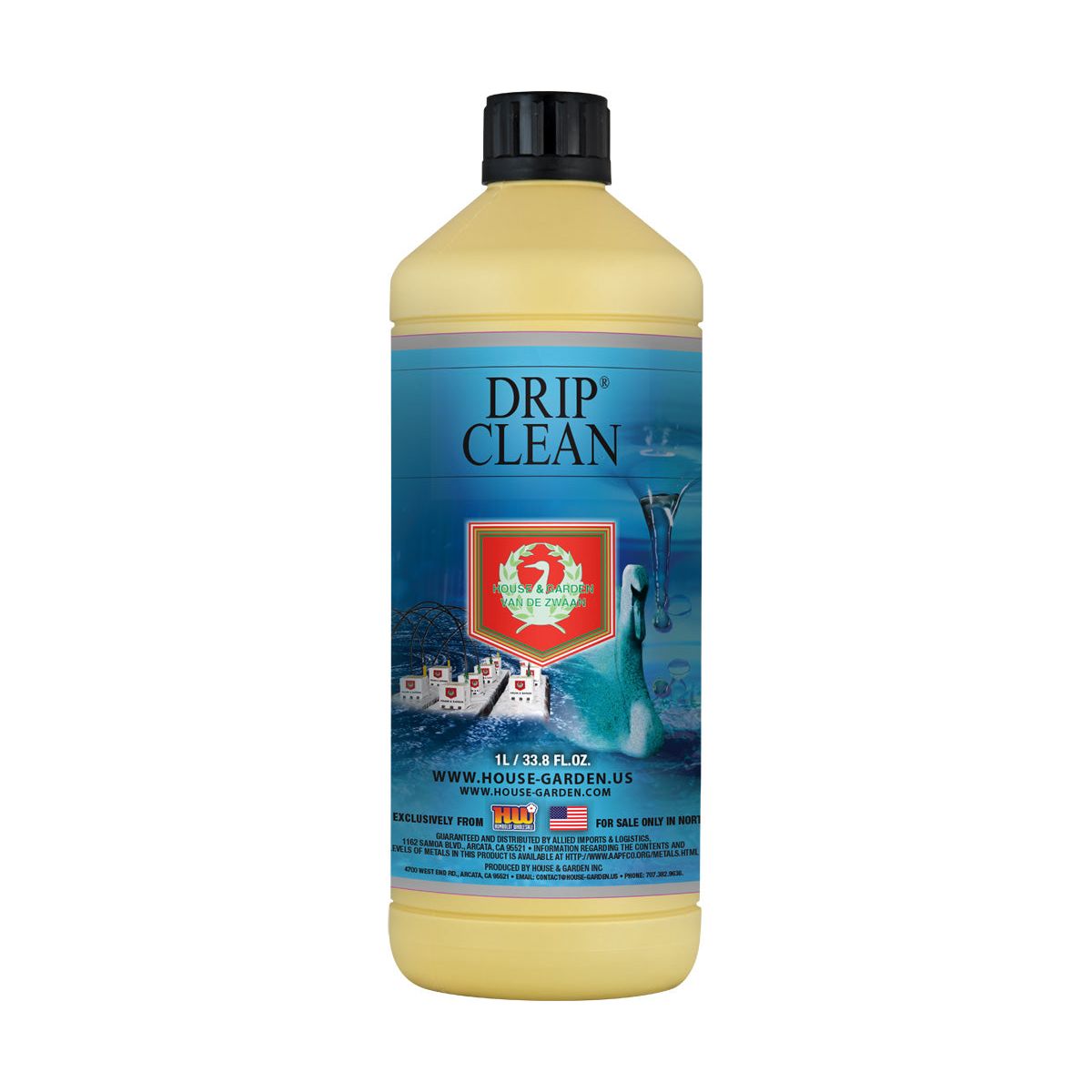
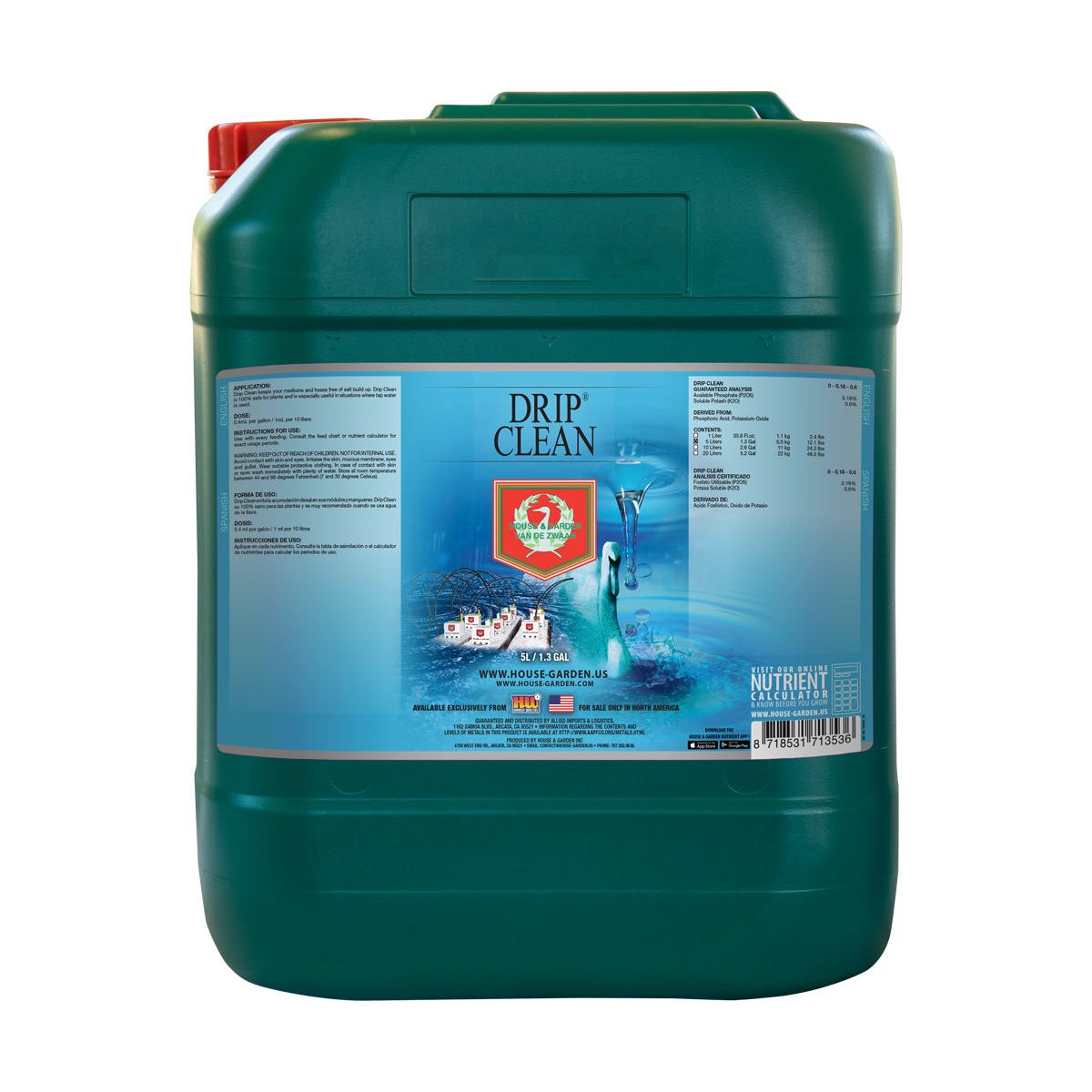
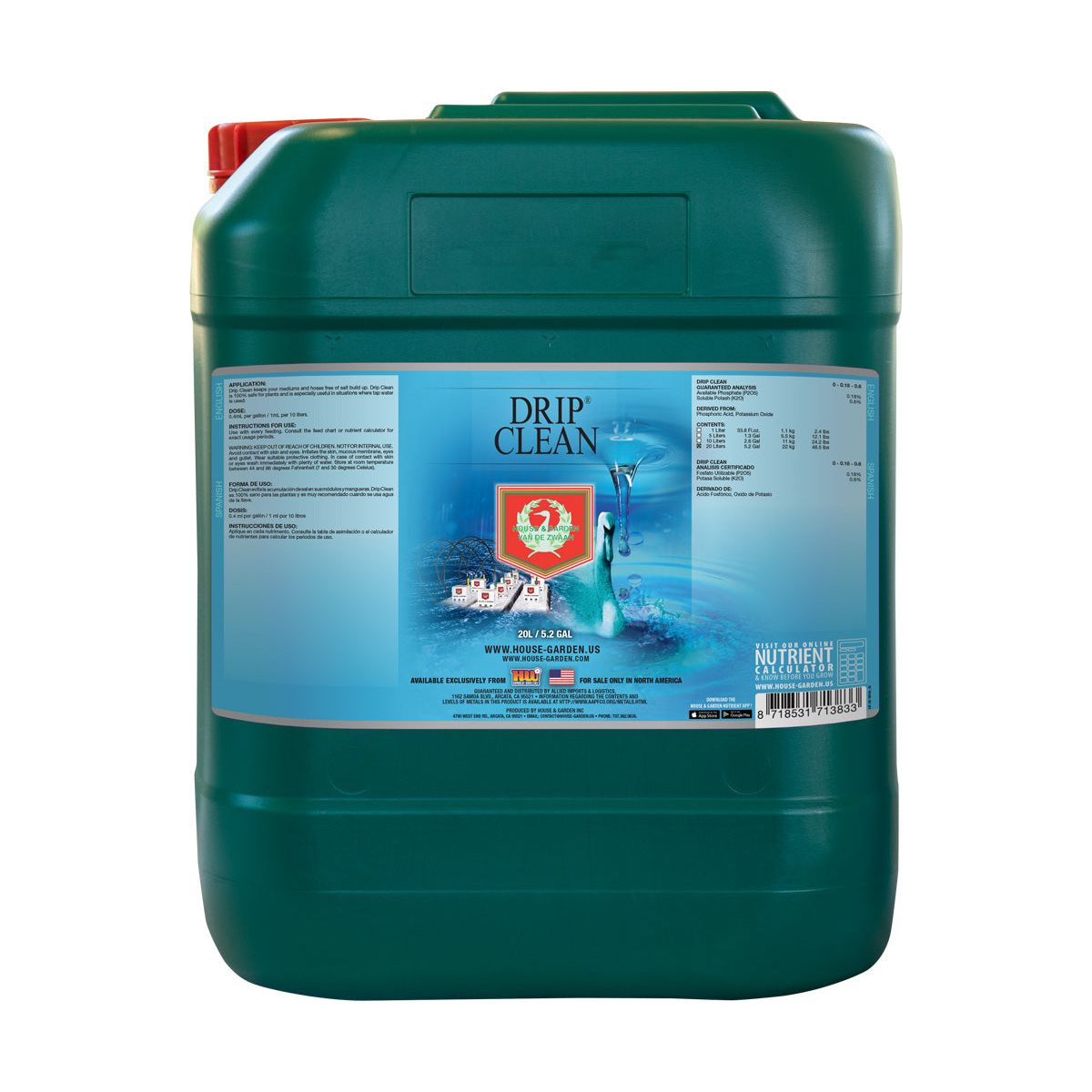
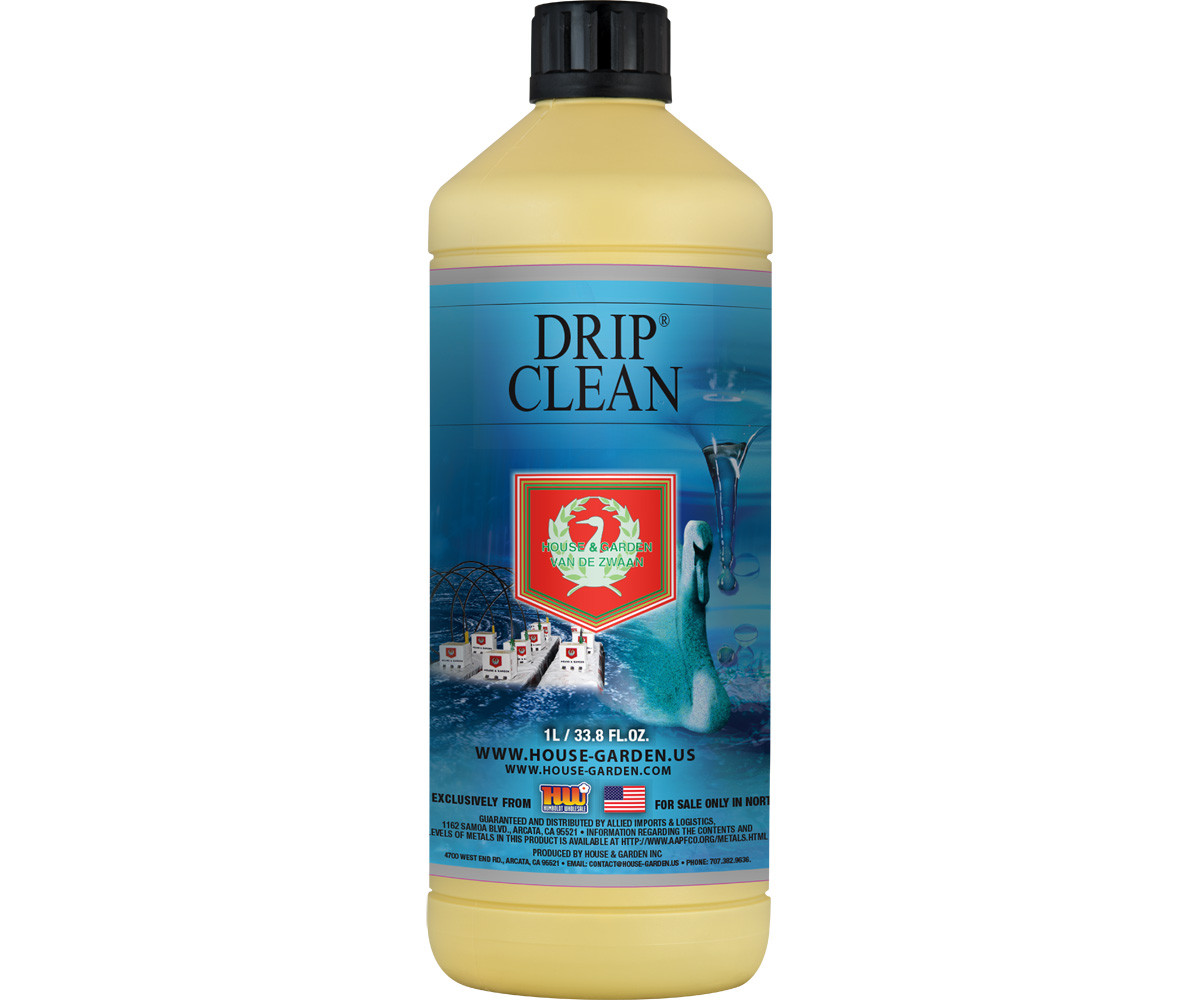


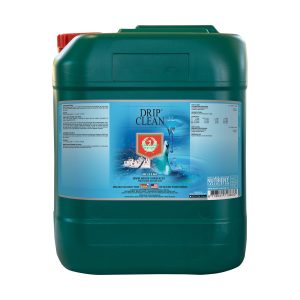
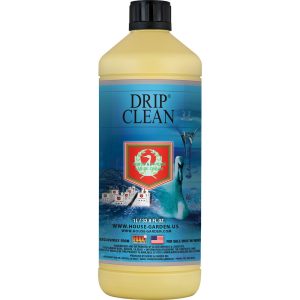

House & Garden Drip Clean is a low-dose liquid additive that keeps growing media, drip lines, hoses, and emitters free of mineral salt build-up. It is 100% safe to use on plants and is especially useful in growing programs that rely on tap water or hard source water where calcium and other dissolved salts tend to accumulate in the substrate over time. The 1-liter bottle covers a substantial volume of reservoir water at the recommended dose rate and is compatible with any hydroponic or soil-based system regardless of nutrient program.
House & Garden Drip Clean Specifications
Specifications below are sourced from the canonical product record (supplier SKU HGDPC01L), the House & Garden product line documentation, and the supplier listing at Cultivate Supply.
| Specification | Value |
|---|---|
| Brand | House & Garden |
| Product type | Liquid additive / salt build-up preventer for growing media and irrigation lines |
| Volume | 1 liter (1,000 mL) |
| Shipping weight | ~3.10 lb (3.1041 lb per canonical data) |
| NPK / Guaranteed analysis | 0-0-0 (non-nutrient additive) |
| Primary function | Prevents salt accumulation in growing media, drip lines, hoses, and emitters |
| Application rate | 1 mL per 10 liters of nutrient solution (approx. 0.4 mL per gallon) at every reservoir change |
| Application timing | Every reservoir mix / every watering, through the full vegetative and flowering cycle |
| Form | Liquid concentrate |
| Plant safety | 100% safe for use on plants; will not burn roots at the recommended dose |
| Compatible systems | Drip irrigation, hand-watering, ebb & flow, DWC, NFT, run-to-waste, soil and coco |
| Nutrient compatibility | Compatible with House & Garden Aqua Flakes, Cocos, Soil A&B and any competitor base nutrient line |
| Supplier SKU | HGDPC01L |
| Available sizes in product line | 250 mL, 500 mL, 1 L, 5 L, 20 L |
Why Choose House & Garden Drip Clean
Drip Clean addresses a specific maintenance problem that affects most recirculating and drip-fed hydroponic operations: the gradual accumulation of mineral salts in growing media, irrigation hoses, and drip emitters. The points below cover what the product does, how it differs from cleaning or flushing products, and where it fits in a feeding program.
- Used continuously, not as a flush. Unlike a root flush solution or end-of-cycle cleaner, Drip Clean is dosed at every reservoir mix throughout the grow cycle. It prevents salts from precipitating and binding to media, hoses, and emitter surfaces in the first place rather than dissolving build-up after the fact. The continuous-use approach is the reason the dose rate is so low (1 mL per 10 L) and the reason a 1-liter bottle covers a substantial volume of reservoir water.
- Particularly useful with tap water and hard source water. House & Garden documents Drip Clean as especially useful in setups where tap water is the source. Municipal water typically contains dissolved calcium, magnesium, sodium, and chloride salts on top of whatever nutrients you add. Over weeks of feeding, those salts deposit on the inside of irrigation lines, around drip emitters, and within the growing medium. Drip Clean keeps those deposits in solution so they exit the system with each drain or runoff cycle.
- Plant-safe at the recommended dose. The product is documented as 100% safe to use on plants. At 1 mL per 10 L it does not meaningfully affect EC or pH, so it can run from week one of vegetative growth through harvest without root burn or interference with other feeding inputs.
- Protects drip irrigation hardware. Drip lines and emitters are the most common failure point in a hydroponic system because they have the smallest internal diameter and the most surface area exposed to mineral deposition. A clogged emitter underwaters a single plant and creates stress that is hard to diagnose. Continuous Drip Clean dosing keeps the inside of the drip system clear so emitters maintain their rated flow rate over the life of the equipment.
- Reduces media replacement cost in long-cycle grows. Coco, soil, and rockwool can become salt-loaded after multiple feeding cycles, particularly in run-to-waste systems where high-EC feeds push salts into the substrate that are never fully flushed out. Drip Clean reduces the rate at which the substrate becomes salt-bound, extending the useful life of a media charge.
- Compatible with any nutrient program. Drip Clean slots into the House & Garden additive stack alongside Roots Excelurator, Top Booster, Bud-XL, and Shooting Powder, and it works with any competitor base nutrient line as well. No need to switch from General Hydroponics, Botanicare, or Advanced Nutrients to use it.
- One bottle covers a long reservoir window. At 1 mL per 10 L, a 1-liter bottle treats 10,000 liters (about 2,640 US gallons) of mixed nutrient solution. For a 50 L reservoir changed weekly, that is roughly 200 reservoir changes. Larger commercial operations are better served by the 5 L and 20 L sizes.
Best Uses for House & Garden Drip Clean
Drip Clean is categorized under Nutrients & Additives > Additives > Growth & Bloom Boosters in our taxonomy, though its function is closer to a maintenance additive than a yield enhancer. The use cases below reflect documented application contexts where the product earns its place in a feeding program.
- Drip irrigation and run-to-waste systems with mineral-rich source water. The product takes its name from drip systems for a reason: continuous low-volume delivery through narrow emitters is the situation where salt build-up causes the most operational headache. For a drip-fed coco or rockwool program on municipal tap water, Drip Clean is the most direct way to reduce emitter clogging and substrate salt-loading over a full cycle.
- Recirculating reservoir systems (DWC, ebb & flow, NFT). Even without drip hardware to clog, dissolved salts gradually deposit on plumbing, root chamber surfaces, and pump impellers. Drip Clean keeps those surfaces cleaner between full reservoir flushes. In bucket-style DWC programs, a clean root environment pairs naturally with root-zone additives like Heavy 16 Roots.
- Multi-cycle operations reusing the same growing media. Commercial growers who reuse coco, soil, or rockwool slabs across multiple crop cycles benefit substantially from continuous Drip Clean dosing. The product slows the rate at which media becomes unusably salt-loaded, allowing more cycles before the substrate has to be replaced.
- Programs combining House & Garden base nutrients with the full additive line. Drip Clean is part of the House & Garden stack alongside Roots Excelurator, Bud-XL, Top Booster, Shooting Powder, and Magic Green. It is dosed from the first reservoir change of vegetative growth through harvest as the maintenance backbone of the regimen. For growers also running bacterial root-zone additives, Advanced Nutrients Tarantula addresses a different function and runs in the same reservoir without interference.
- Areas with hard well water or high-TDS municipal supply. Growers in regions with hard well water see the most dramatic benefit because the source water carries significant mineral load before nutrients are added. Drip Clean is not a substitute for reverse osmosis in extreme cases, but it substantially reduces the maintenance burden in mid-hardness situations where RO is not economically justified.
- Small home setups where regular system tear-down is impractical. Home tent growers often do not have space or time to fully disassemble drip hardware between cycles. Continuous Drip Clean dosing keeps the system internally cleaner during operation, so a quick reservoir flush at the end of each cycle is enough to maintain reliable function.
Drip Clean vs Similar Products
Drip Clean occupies a specific niche in the additive market: continuous-use, low-dose salt prevention rather than periodic flushing or post-cycle cleaning. The comparison below lays out how Drip Clean differs from the two adjacent product categories growers most often consider as alternatives — root flushes (such as Florakleen or Clearex) and reverse-osmosis filtration as a source-water solution.
| Factor | House & Garden Drip Clean | Root flush products (Florakleen, Clearex) |
|---|---|---|
| Application timing | Every reservoir mix, continuously through the full grow cycle | Periodic flush (mid-cycle correction or pre-harvest), not continuous |
| Dose rate | 1 mL per 10 L (very low, no significant EC impact) | High dose during flush (4–5 mL/L or higher), used in plain water without base nutrients |
| Mechanism | Prevents salt precipitation and binding to media / equipment in the first place | Dissolves accumulated salts after the fact, releasing them from substrate for drainage |
| Use with base nutrients | Yes — added alongside base nutrients at every reservoir mix | No — used in plain water with no base nutrients during flush window |
| Effect on plants during application | None — continues normal feeding | Plants temporarily nutrient-deprived during flush; not for use mid-bloom in most programs |
| Primary protected surface | Drip emitters, hoses, growing media, root zone surfaces | Growing media and root zone (does not protect emitters or hoses) |
| Coverage at recommended dose | 1 L bottle treats ~10,000 L of nutrient solution | 1 L bottle treats ~200 L at flush dose (very different consumption profile) |
The practical takeaway is that Drip Clean and root flushes solve different problems and are not direct substitutes. Drip Clean is the maintenance product that runs through the entire grow cycle to prevent build-up; a root flush is the corrective product used when build-up has already become a problem, or used pre-harvest to clear nutrient residue from the plant. Many growers use both in the same program: Drip Clean continuously through the cycle to minimize the rate of accumulation, plus a periodic root flush at end-of-cycle. Compared to reverse-osmosis filtration of source water, Drip Clean addresses the symptom (mineral deposition inside the system) rather than the cause (high TDS in source water); growers with very hard source water often pair Drip Clean with partial RO blending for the most reliable long-term outcome.
Compatibility & Operating Range
Drip Clean is a low-impact additive that fits into almost any feeding program. The notes below cover documented compatibility with system types, nutrient lines, and source water as well as the small number of situations where care should be taken.
- Hydroponic system types: Drip irrigation (primary use), NFT, ebb and flow, deep water culture (DWC), and run-to-waste setups. The very low dose rate has no measurable effect on flow rates or pump performance and adds no foaming or sediment to the reservoir.
- Growing media: Compatible with coco coir, rockwool, perlite, clay pebbles, peat-based soilless mixes, and standard soil. Same dose rate across all substrates.
- Base nutrient compatibility: Documented compatible with the full House & Garden base program (Aqua Flakes A&B, Cocos A&B, Soil A&B, Hydro A&B) and with any competitor line including General Hydroponics, Botanicare, Advanced Nutrients, and Cyco. NPK 0-0-0, so it does not interfere with the balanced ratios of a base nutrient line.
- House & Garden additive stack: Designed to work alongside Roots Excelurator, Top Booster, Bud-XL, Shooting Powder, and Magic Green. Drip Clean is the maintenance backbone of the program and is dosed at every reservoir change regardless of which other additives are in the feed.
- Source water: Most beneficial with tap water and hard source water where mineral content is the primary driver of build-up. With pure reverse-osmosis source water (very low baseline TDS), the benefit is reduced because less dissolved salt enters the system, but it does not cause harm and continues to manage any salt contributed by the nutrient inputs.
- pH range: Compatible with the standard hydroponic pH range of 5.5–6.5. No significant effect on reservoir pH at the recommended dose.
- EC impact: At 1 mL per 10 L the contribution to reservoir EC is negligible — below the noise floor of most reservoir meters. No need to adjust target EC to account for Drip Clean.
- Storage: Room temperature in the sealed original bottle, away from direct sunlight. Avoid freezing; if the bottle freezes in transit, allow to fully thaw and shake before use.
- Crop protection compatibility: Compatible with standard biological crop protection products at label rates. A foliar program using PureCrop1 or similar plant-based products does not interact with Drip Clean in the reservoir. Follow individual product labels for any specific incompatibility warnings.
Dosing Guidelines
Drip Clean is dosed once per reservoir mix at a fixed rate, regardless of growth stage. Unlike products that change dose between veg and bloom or that taper off near harvest, Drip Clean is added at the same rate from the first watering of seedlings through the last watering before harvest. The table below summarizes the dose for common reservoir sizes.
| Reservoir Size | Drip Clean Dose | Reservoir Size (Gallons) | Notes |
|---|---|---|---|
| 10 L | 1 mL | ~2.6 US gal | Small bucket / hand-watering can |
| 20 L | 2 mL | ~5.3 US gal | Single DWC bucket reservoir |
| 50 L | 5 mL | ~13 US gal | Small tent reservoir, 2–4 plant setup |
| 100 L | 10 mL | ~26 US gal | Mid-size flood & drain or NFT loop |
| 200 L | 20 mL | ~53 US gal | Large recirculating reservoir, commercial bench |
| 500 L | 50 mL | ~132 US gal | Commercial drip system feed tank |
| 1,000 L | 100 mL | ~264 US gal | Large commercial reservoir; use 5 L or 20 L size for efficiency |
Bottle coverage: 1,000 mL of concentrate at 1 mL per 10 L treats 10,000 liters (~2,640 US gallons) of reservoir water. A 50 L reservoir changed weekly is roughly 200 reservoir changes per bottle — years of home-scale operation. Commercial operations running 200 L+ weekly typically buy the 5 L or 20 L size.
Measurement: For small reservoirs (10–20 L), use a graduated pipette or 1 mL syringe for accuracy. For larger reservoirs, a 25 mL or 50 mL measuring cup is sufficient. The dose is forgiving of small inaccuracies because the active concentration is so low.
How to Use Drip Clean
The steps below cover incorporating Drip Clean into an existing feeding program. Because the product is used at every reservoir change, the routine becomes part of the standard mixing procedure rather than a separate maintenance event.
- Shake the bottle before measuring. The concentrate is stable but gentle inversion before drawing a dose ensures consistent concentration across the life of the bottle.
- Fill the reservoir with source water. Use whatever water source you normally use for the reservoir — tap water, well water, partially filtered water, or RO. Drip Clean works across all of these, with greater benefit on harder water sources.
- Calculate the dose for your reservoir size. The rate is 1 mL of Drip Clean per 10 liters of reservoir water. For US-gallon reservoirs, the equivalent is approximately 0.4 mL per gallon. Use the dosing table above as a quick reference for common reservoir sizes.
- Measure the dose. Use a syringe, graduated pipette, or small measuring cup depending on the volume needed. For very small home reservoirs, a 1 mL or 5 mL syringe is the most accurate option.
- Add Drip Clean to the reservoir water. Pour the measured dose directly into the reservoir water and stir or allow the recirculation pump to mix it through. Because the dose is so low, Drip Clean disperses quickly through the reservoir volume.
- Add base nutrients and other additives in your normal order. Drip Clean does not require any specific addition order relative to other inputs. It can be added before or after base nutrients and supplements without affecting performance. Many growers add Drip Clean first because it is the lowest-volume addition and easy to dose into plain water.
- Adjust pH and verify EC. After all inputs have been added, check the reservoir pH and adjust to your target (typically 5.5–6.2 for hydroponic systems, slightly higher for soil-based systems). Verify EC is in the target range for the current growth stage. Drip Clean does not meaningfully affect either reading at the recommended dose.
- Repeat at every reservoir change. Drip Clean is added every time you mix a fresh reservoir, from the first watering of the cycle through the last watering before harvest. There is no stage of the grow where Drip Clean is omitted; the continuous use is what prevents build-up from accumulating.
- For drip-fed systems, run the system briefly after mixing. If you are using a drip irrigation setup, run the pump for a short cycle after adding Drip Clean to ensure the treated water moves through the full length of the hoses and reaches the emitters. This is what gives the product the chance to keep the inside of the drip hardware clean.
- Pair with an end-of-cycle flush as needed. Drip Clean reduces but does not eliminate the need for a pre-harvest flush. Most growers still perform a standard flush in the final 1–2 weeks of flowering to clear nutrient residue from the plant. Drip Clean continues to be added during the flush window in some programs and is omitted in others — both approaches are documented in the House & Garden feeding charts and either is acceptable.
- Store the bottle correctly between uses. Cap securely after each use. Store at room temperature away from direct sunlight. The product remains stable for the life of the bottle when stored sealed.
Sources & Further Reading
| Weight | 3.1041 lbs |
|---|---|
| Brand | House & Garden |
Be the first to review “House & Garden Drip Clean – 1 Liter”
Related products


Growth & Bloom Boosters


Growth & Bloom Boosters

Growth & Bloom Boosters


Growth & Bloom Boosters

Growth & Bloom Boosters


Growth & Bloom Boosters


Growth & Bloom Boosters


Growth & Bloom Boosters
Reviews
There are no reviews yet.